Agribusiness Chamber unveils 12-month plan to end Ghana’s tomato import dependence
— Anita okhipo
Ghana’s Agribusiness Chamber has launched a 12-month plan to end the country’s heavy reliance on imported tomatoes. The strategy focuses on boosting local production through irrigation, farmer support, and reviving processing facilities. If successful, it could improve food security, reduce imports…
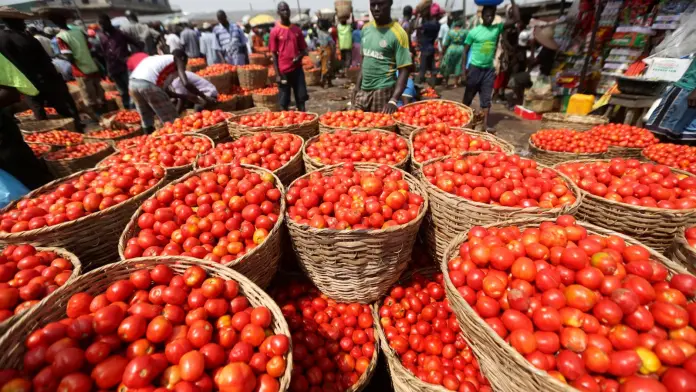
ACCRA, GHANA — Ghana is taking a decisive step toward food self-sufficiency as the Chamber of Agribusiness Ghana (CAG) unveils an ambitious 12-month national strategy aimed at ending the country’s heavy reliance on imported tomatoes.
The plan comes in response to a major supply shock triggered by Burkina Faso’s ban on fresh tomato exports, a move that has exposed Ghana’s dependence on external sources for up to 90 percent of its dry-season tomato supply.
A Crisis Turned Opportunity
For years, Ghana has struggled with a significant gap between tomato demand and local production. The country requires about 800,000 metric tonnes annually, yet produces only around 510,000 metric tonnes, leaving a deficit that has been filled by imports.
The Agribusiness Chamber sees the current disruption not as a setback, but as a turning point.
“This is not a long-term aspiration; it is a 12-month mission,” the Chamber emphasized, positioning the initiative as a fast-track solution to a long-standing agricultural challenge.
Inside the 12-Month Transformation Plan
The roadmap is structured into seven phases, each targeting key weaknesses in Ghana’s tomato value chain — from production to processing and distribution.
The strategy includes:
-
Massive irrigation expansion, including rehabilitation of major schemes like Tono and Vea
-
Deployment of 15,000 hectares of drip irrigation systems to enable year-round farming
-
Distribution of certified seeds, fertilisers, and farmer financing support
-
Revival of dormant tomato processing plants in Pwalugu, Wenchi, and Techiman
-
Establishment of aggregation and cold storage systems to reduce post-harvest losses
Post-harvest losses currently account for 20% to 50% of locally produced tomatoes, highlighting the urgency of improving storage and logistics infrastructure.
Private Sector and Government Collaboration
A key pillar of the plan is a public-private partnership model, anchored by the Grow Ghana Agro-Corporate Partnership Framework. This initiative aims to attract both local and international investors to scale production and processing capacity.
The Chamber is also calling for:
-
A GH¢430 million government investment to fund critical interventions
-
Policy reforms, including higher tariffs on imported tomato paste
-
Anti-dumping measures to protect local producers from unfair competition
Expected Impact
If successfully implemented, the strategy could:
-
Increase production to over 800,000 metric tonnes annually
-
Reduce imports of tomato paste by up to 40 percent
-
Create jobs across farming, logistics, and agro-processing sectors
-
Stabilize tomato prices and improve food security nationwide
The plan also includes the development of Tomato Agro-Industrial Zones, designed to position Ghana as a competitive producer within the West African region.
A Race Against Time
The urgency of the initiative cannot be overstated. The Burkina Faso export ban has already led to rising prices, supply shortages, and income losses for traders, placing pressure on both consumers and businesses.
Agriculture officials warn that without swift implementation, the country could face prolonged disruptions in food supply.
A Path to Food Sovereignty
Despite the challenges, experts believe Ghana has the resources needed to succeed — including fertile land, a strong farming base, and a growing domestic market.
What has been missing, they say, is coordination.
Now, with a clear 12-month roadmap in place, Ghana is aiming to transform its tomato sector from import-dependent to self-sufficient — turning a regional crisis into a catalyst for long-term agricultural reform.
Agribusiness Chamber unveils 12-month plan to end Ghana’s tomato import dependence