No Athlete Village: The Asian Games Experiment Every Host Should Study
— Afridiaspo Sports Desk
The 2026 Asian Games used hotels, modular cabins and a cruise ship instead of one athlete village. What worked, what failed and lessons for African hosts.
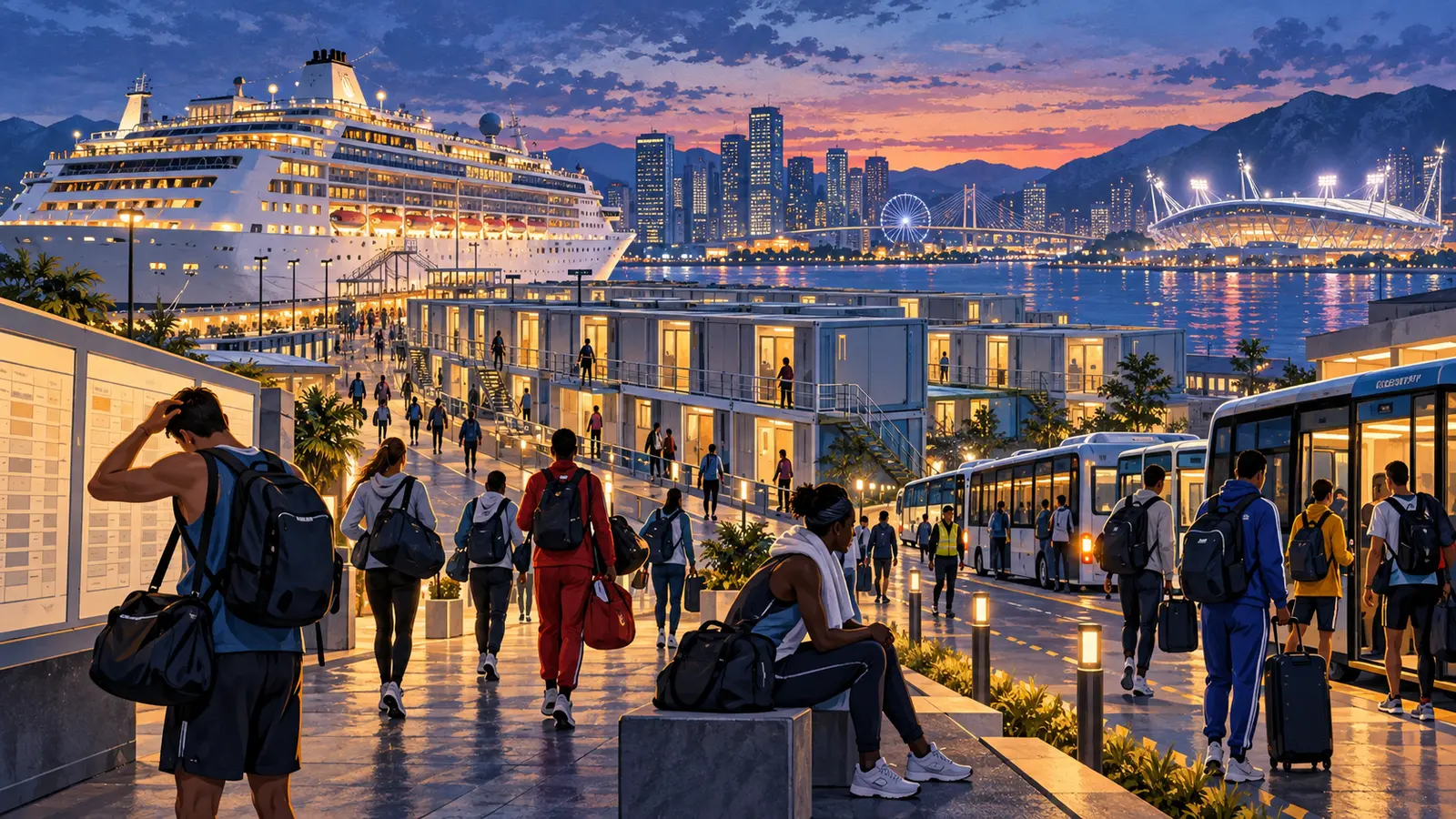
The 2026 Asian Games tried to solve one of international sport’s most expensive problems: what happens to an athletes’ village after everyone goes home.
Instead of building a single permanent complex for thousands of competitors and officials, organizers in Aichi and Nagoya spread accommodation across hotels, modular cabin-style units and a cruise ship. The logic was serious. A purpose-built village can become a costly “white elephant”—too large for local demand, expensive to maintain and difficult to convert once the medals have been awarded.
But the first days of the Games exposed the other side of that choice. Athletes and team officials reported cramped rooms, insufficient beds, booking errors, transport failures and disruption linked to flooding. South Korea’s delegation issued unusually direct criticism. India moved its cricket team into separate accommodation. Organizers defended the overall system and promised fixes, while International Olympic Committee President Kirsty Coventry gave a more positive assessment after inspecting facilities.
The disagreement is bigger than one event. It goes to the heart of modern mega-sport: can a host cut construction costs and environmental waste without transferring the burden to athletes?
The Asian Games experiment at a glance
- Event: 20th Asian Games, Aichi-Nagoya, Japan
- Dates: September 19–October 4, 2026
- Scale: About 17,000 athletes and officials from 45 countries and regions
- Programme: 469 medal events across 43 sports
- Housing model: Hotels, modular cabin units and a docked cruise ship instead of one traditional athletes’ village
Why hosts fear the traditional village
An athletes’ village is often presented as part dormitory, part symbol. It brings competitors together, simplifies food and medical services and gives an event a social centre. It can also require an enormous upfront commitment before a single athlete arrives.
The financial risk is not just construction. A host must decide who will own the buildings afterward, whether local residents can afford them, how transport will connect them to the city and who will pay for long-term maintenance. If those questions are weak, “legacy” can become a polite word for an asset that the public continues to fund without fully using.
Aichi-Nagoya chose a different path. By relying on existing hotels, temporary units and maritime accommodation, organizers attempted to reduce permanent construction and avoid creating a complex with no convincing post-Games purpose. The Olympic Council of Asia defended the model as a practical answer to the white-elephant problem.
That reasoning deserves to be taken seriously. The mistake would be to assume that temporary infrastructure is automatically simple infrastructure.
The village did not disappear—the work multiplied
A conventional village concentrates athletes, dining, transport, security, medical support and information services in one managed environment. Remove that central campus and the host must reproduce those functions across several different types of property.
A hotel operates differently from a modular cabin site. A cruise ship has maritime safety systems, narrow room configurations and its own booking inventory. A distributed housing network also creates more transport routes, more access-control points and more places where a communication error can separate an athlete from a bed, a meal or a scheduled practice.
In other words, Aichi-Nagoya did not eliminate the village. It turned one village into a network.
Networks can be flexible and efficient. They can also fail at the connections.
| Decision | Intended benefit | Risk exposed in Nagoya | Lesson for future hosts |
|---|---|---|---|
| No permanent village | Lower capital exposure and less risk of an unused post-Games complex | Accommodation services became fragmented across multiple operators | Create one command system even when beds are distributed |
| Modular cabins | Fast deployment, removability and scalable capacity | Complaints about space, beds and weather-related disruption | Test comfort, drainage, power and emergency procedures under real conditions |
| Cruise-ship rooms | Thousands of ready-made rooms near a major port | Booking and room-allocation errors, plus confined layouts | Audit every berth against delegation lists before arrivals |
| Existing hotels | Use established hospitality stock instead of new construction | Teams spread farther from venues and from one another | Treat transport frequency and backup vehicles as part of housing—not a separate service |
| Distributed venues and housing | Reuse more existing assets across the region | A missed shuttle could become a missed practice | Build redundancy into every athlete-critical journey |
What athletes reported
The most serious criticism came from the South Korean delegation. Its chef de mission cited inadequate accommodation, room shortages and transport failures. The men’s basketball team had to move after flooding affected its original housing, and a missing shuttle caused a practice cancellation. Booking problems also affected cruise-ship rooms.
These were not aesthetic complaints. For elite competitors, sleep, travel time and access to training are performance conditions. A room that feels merely inconvenient to a tourist can become consequential when its occupant has a final the next morning.
That distinction matters. Athlete welfare does not require luxury. It requires reliability: an appropriate bed, functioning climate control, sufficient recovery space, predictable meals, secure transport and accurate information.
Organizers acknowledged problems but argued that the system was broadly operating. Coventry’s inspection produced a more reassuring assessment. She praised the quiet environment and air conditioning and noted that compact athlete accommodation is not unprecedented.
Both positions can be true. A facility may meet basic standards during an inspection while individual teams experience serious failures in allocation, transport or contingency planning. The central question is not whether every room was poor. It is whether the system could identify and correct failures quickly enough to protect competition.
Sustainability is not only about buildings
Mega-events often measure sustainability through visible assets: how many venues already existed, how much concrete was avoided, whether temporary structures can be removed and how much carbon construction produced.
Those measures matter. But a genuinely sustainable event must also be operationally sustainable. That includes staff capacity, procurement controls, accessible transport, heat and flood resilience, reliable power and a complaints system capable of responding in hours rather than days.
A cheaper housing model that requires emergency hotel bookings, repeated transfers or last-minute vehicle deployments may still be better than an unnecessary permanent village. Yet those rescue costs—and the athlete disruption behind them—must be counted honestly.
The strongest lesson from Nagoya is therefore not “build a village” or “never build one.” It is that legacy planning and athlete experience must be designed together. Saving the city from a white elephant cannot mean asking athletes to absorb the planning risk.
Why African host cities should study this closely
The lesson is especially relevant across Africa, where major-event ambitions often collide with limited public budgets, infrastructure gaps and justified public concern about prestige projects that do not meet everyday needs.
Dakar is preparing to host the Youth Olympic Games from October 31 to November 13—the first Olympic sporting event on African soil. The scale and accommodation plan are different from the Asian Games, so Nagoya is not a direct template. But its experience offers a timely warning: using temporary or existing assets can be financially intelligent only when the service connecting those assets is stronger than the concrete it replaces.
Future African hosts should resist a false choice between extravagance and improvisation. A host does not need to copy the most expensive Olympic model. It does need to guarantee the basics with almost obsessive detail.
Six questions every future host should answer
- Who owns the athlete journey? One operations centre must see room assignments, transport, meals and venue access together.
- Has temporary housing been stress-tested? Test drainage, heat, electricity, internet, accessibility and emergency evacuation before delegations arrive.
- Is there transport redundancy? Every practice and competition route needs backup vehicles and real-time escalation.
- Are room inventories reconciled daily? Delegation lists, beds and arrival changes must match across every accommodation operator.
- Can complaints trigger action quickly? Teams need a multilingual help desk with authority—not merely a form.
- What remains after the Games? Temporary units, upgraded hotels, transit improvements and public facilities should have a documented next use.
The real meaning of a lean Games
A lean event is not simply one that builds less. It is one that wastes less while still protecting the people who make the event possible.
Aichi-Nagoya’s experiment may yet produce valuable evidence for future hosts. The Games run through October 4, giving organizers time to stabilize operations and show whether a distributed model can recover after a difficult opening. The event’s successes and failures should be documented with the same seriousness as its medal table.
For Africa, the takeaway is not to abandon ambitious sport. It is to define ambition more intelligently. A stadium is not a legacy if local athletes cannot use it. A temporary village is not sustainable if its systems fail. A cheaper Games is not truly efficient if competitors lose sleep, transport or training time.
The best host will not be the one that spends the most—or the one that cuts the deepest. It will be the one that understands where permanence creates public value, where temporary infrastructure makes sense and where reliability cannot be negotiated.
Sources: Event scale and programme were verified through Reuters’ Asian Games facts and figures and the official Olympics coverage. Accommodation and opening-week problems were reported by Reuters on September 19. Coventry’s inspection was covered by Reuters on September 20. South Korea’s formal criticism and organizers’ response were reported by Reuters on September 22.
No Athlete Village: The Asian Games Experiment Every Host Should Study