AfriDiaspo is your daily source for African diaspora news, Afrobeats music, African business stories, diaspora events, immigration updates, African fashion, Nollywood, and African success stories — covering all 54 African countries and diaspora communities in the US, UK, Canada, France, Germany, and beyond.
Nollywood’s 50,000-Seat Bet Is Bigger Than a Record
— Afridiaspo Entertainment Desk
Black Market is targeting 50,000 people at its Lagos premiere. Afridiaspo examines the Guinness attempt, cinema economics and what success would mean.
Nollywood is trying to turn one film premiere into an audience the size of a small city.
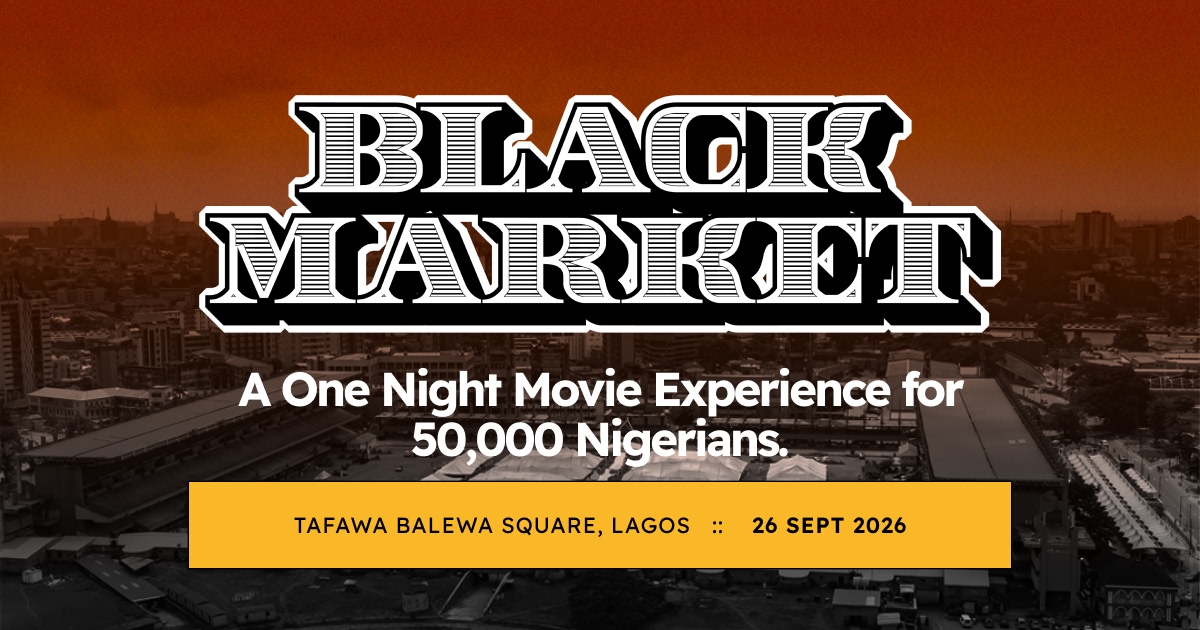
On Saturday, September 26, the team behind Black Market is attempting to gather 50,000 people at Tafawa Balewa Square in Lagos for a single screening. If the attendance is verified at that level, the event would exceed the current Guinness World Records benchmark for the largest audience at a film premiere: 43,624 people at the 2015 premiere of the Filipino biographical film Felix Manalo.
But the careful word is attempting. The organizers’ target is not yet a record, and a packed square is not enough by itself. Attendance has to be counted and validated under the record authority’s rules. Until Guinness World Records confirms the evidence, Black Market remains an ambitious Nigerian film premiere with a potentially historic result—not a certified record holder.
That distinction does not make the event less important. It makes the real story more interesting. Nollywood is testing whether cinema can still function as a mass public experience in a streaming age—and whether spectacle can become a durable audience strategy rather than one extraordinary night.
The attempt in five numbers
50,000: the organizers’ target audience at Tafawa Balewa Square.
43,624: the current Guinness World Records benchmark, set in the Philippines on October 4, 2015.
6,376: how many verified attendees above the existing record the Lagos target would represent.
2.8 million: cinema admissions recorded in the 2025 Nigeria Box Office Yearbook.
1.8%: the 50,000-person target as a share of that annual admissions figure—a remarkable concentration for one screening.
What Black Market is actually about
The event’s scale could easily eclipse the film, so it is worth separating the two.
According to the film’s official site, Black Market is a crime drama about five market women operating a cross-border fuel-smuggling network during scarcity. Their system fractures when a rival kidnaps Adesua’s daughter, forcing the group into a dangerous rescue effort where money, loyalty and survival collide.
Fatimah Binta Gimsay directs and co-wrote the film with Abdul Tijani-Ahmed. Nora Awolowo and Nicole Ofoegbu are credited as producers, with Omowunmi Dada and Abdul Tijani-Ahmed as co-producers. The ensemble includes Linda Ejiofor-Suleiman, Omowunmi Dada, Scarlet Gomez, Teniola Aladese, Susan Pwajok, Lateef Adedimeji, Ibrahim Yekini, Andrew Yaw Bunting, Kanaga Eme, Uzor Arukwe, Folagade Banks and Tomiwa Tegbe.
The production was shot in Abeokuta, according to reporting by The Guardian Nigeria. FilmOne Studios, Signet Ring Studios and Switch Visuals Production are among the announced collaborators on the premiere effort.
That creative context matters. A record attempt can attract people who know the stars or want to be part of history, but the film still has to hold their attention. The strongest outcome would be a cultural moment in which the spectacle introduces a durable work—not an event remembered more clearly than the story on the screen.
Official Black Market promotional image showing the filmmakers and ensemble behind the production
The record is precise, not symbolic
Guinness World Records lists the current record as 43,624 people at the Felix Manalo premiere at the Philippine Arena in Ciudad de Victoria. The same event also set the record for the largest attendance at a film screening.
Black Market organizers are targeting 50,000, creating a theoretical margin of 6,376. That buffer is important because record claims depend on the number that can be verified, not the number of tickets distributed, registrations received or people circulating around the venue.
What must be distinguished
What it means
Why it matters
Ticket or registration count
People who planned or paid to attend
It signals demand but does not prove everyone entered or watched.
People inside the event
The crowd physically admitted to the venue
Venue attendance may still differ from the verified screening audience.
Verified screening audience
Attendees counted under the applicable evidence rules
This is the figure relevant to the record claim.
Guinness confirmation
Formal acceptance of submitted evidence
Only confirmation converts an attempt into an official record.
A responsible report therefore should not announce that Nollywood “has broken” the record on the strength of promotional material or crowd images. It should wait for the verified total and formal adjudication.
Why 50,000 people in one place matters
The 2025 Nigeria Box Office Yearbook, compiled by FilmOne from industry data, reported roughly ₦15.6 billion in theatrical revenue and about 2.8 million admissions. Against that scale, a 50,000-person screening would equal about 1.8% of an entire year’s admissions concentrated into one night.
This is not a normal theatrical release model. It is event cinema: the film is packaged with communal participation, stars, brand partnerships, transport planning, merchandise, vendors and the promise of witnessing a historic attempt. The ticket buys access to a story, but also to a social identity—“I was there.”
That strategy answers one of cinema’s biggest problems. A home screen can deliver convenience, pause buttons and lower travel costs. A premiere of this scale offers something streaming cannot reproduce: collective anticipation, public memory and the emotional force of tens of thousands reacting at once.
For the African diaspora, that idea is familiar. Concerts, football matches, religious gatherings and cultural festivals often succeed because attendance expresses belonging. Black Market is asking whether a Nigerian film can command the same public ritual.
The logistics are part of the creative gamble
Tafawa Balewa Square is a civic space, not a conventional multiplex auditorium. A screening on this scale depends on projection visibility, sound distribution, power redundancy, access control, emergency routes, toilets, transport and crowd movement. A record-sized audience that cannot see or hear the film would create publicity without delivering a credible cinema experience.
The official event site promotes transport arrangements and lists partners across telecommunications, mobility, consumer technology, sportswear and Lagos cultural authorities. That partnership model shows how expensive mass exhibition becomes: the production is not only mounting a premiere but temporarily constructing a giant cinema ecosystem.
There is also a storytelling risk. The spectacle can set expectations so high that the film itself is judged against the audacity of the event. Good event design gets the crowd seated. Good cinema gives them something to discuss after the lights come back on.
Official Puma and Black Market campaign photograph featuring branded film merchandise
A record cannot answer the box-office question
Even if Guinness verifies 50,000 attendees, the result will not automatically establish Black Market as a commercial hit. A record premiere measures the success of one attendance campaign. Box-office endurance is measured by paid admissions across subsequent days, locations and audiences.
The industry should watch what happens next:
Does the premiere convert into strong conventional cinema demand?
Do audiences recommend the film because of its story and performances, not only the record attempt?
Can distributors turn the event’s visibility into regional and diaspora releases?
Will sponsors and exhibitors treat mass premieres as repeatable investments?
Does the data—tickets, verified attendance and later box office—become publicly transparent?
If those answers
are positive, the experiment could expand Nollywood’s release playbook. Producers might combine cinemas, public spaces, fan communities and diaspora screenings into coordinated launches. If the attention disappears after one night, the event will still be memorable, but less transformative.
The women behind the screen matter too
The headline is built around a huge crowd, but Black Market is also a major production led by women in central creative and producing roles. Gimsay directs and co-writes; Awolowo and Ofoegbu produce; Dada serves as co-producer and stars in the film; several women anchor the story’s smuggling crew.
That matters in an industry conversation too often reduced to stars and box-office totals. A successful launch would also demonstrate the scale on which women-led Nigerian production teams can conceive, finance, organize and market ambitious popular cinema.
The Afridiaspo takeaway
Black Market is making two bets at once. The first is measurable: that at least 43,625 people can be assembled, counted and verified for a film premiere. The second is harder: that the crowd will prove African cinema can create a live cultural experience powerful enough to compete with the convenience of streaming.
The first bet belongs to Guinness World Records. The second belongs to audiences.
If 50,000 people show up, the image will travel around the world. If they leave talking about the film, Nollywood will have achieved something bigger than a certificate.
This article describes an ongoing record attempt. It does not state that a record has been achieved; formal confirmation must come from Guinness World Records.
Image credits: Official Black Market campaign poster and promotional photographs — Black Market / Rixel Studios. These images provide editorial identification and context; they are not evidence that the attendance record was achieved.