Global South Diaspora Foundation Wants to Turn Diaspora Power Into Development Infrastructure
— Afridiaspo Editorial Desk
Inside the Global South Diaspora Foundation’s proposal to organise diaspora investment, expertise and networks for accountable development.
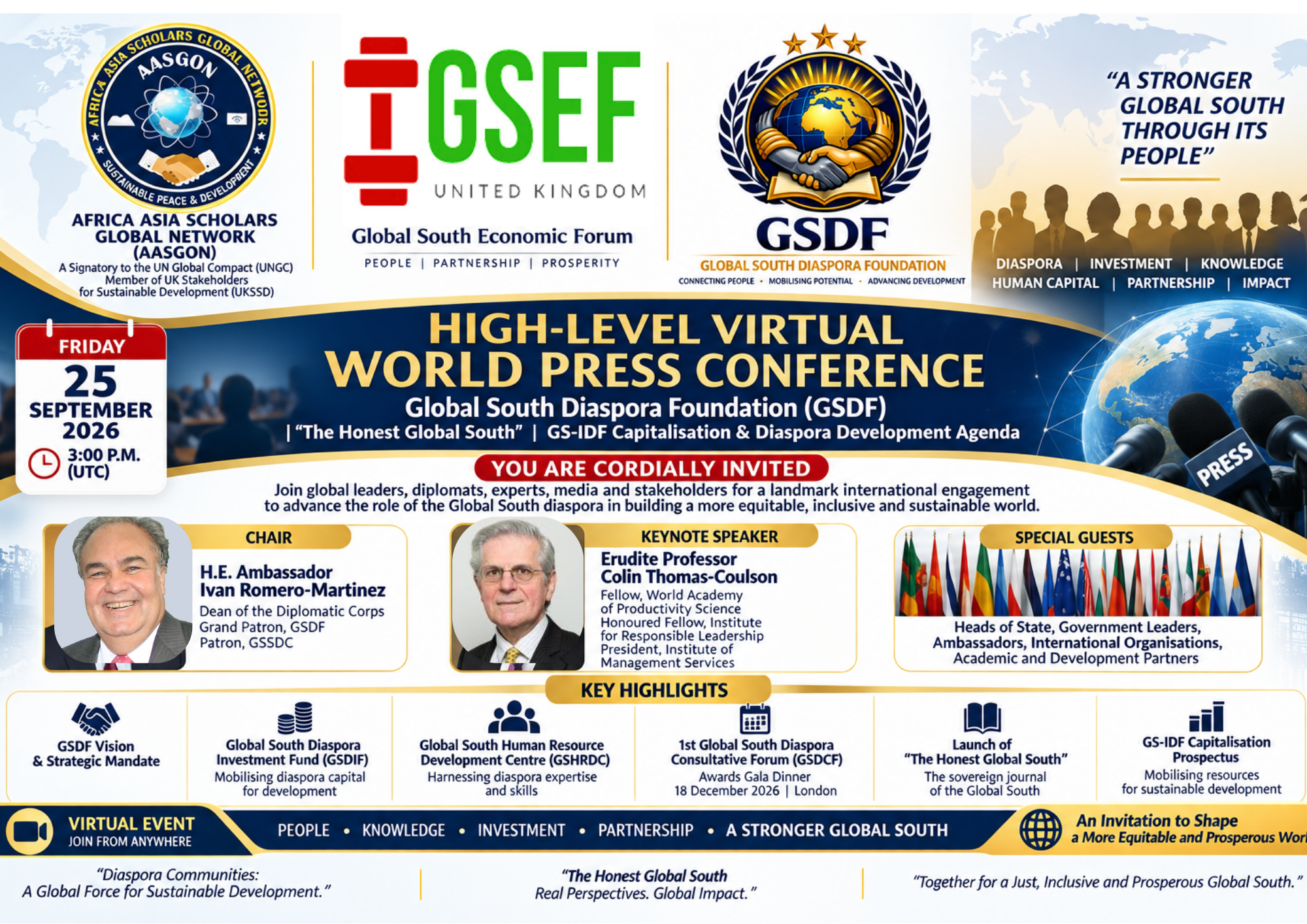
African and Global South diasporas are often discussed in terms of remittances: how much money they send home, how often they invest, and how quickly that money reaches families. The Global South Diaspora Foundation wants to push that conversation further. Its emerging proposal is to organise diaspora capital, professional knowledge, research networks and institutional relationships into a development system rather than leaving them as scattered individual contributions.
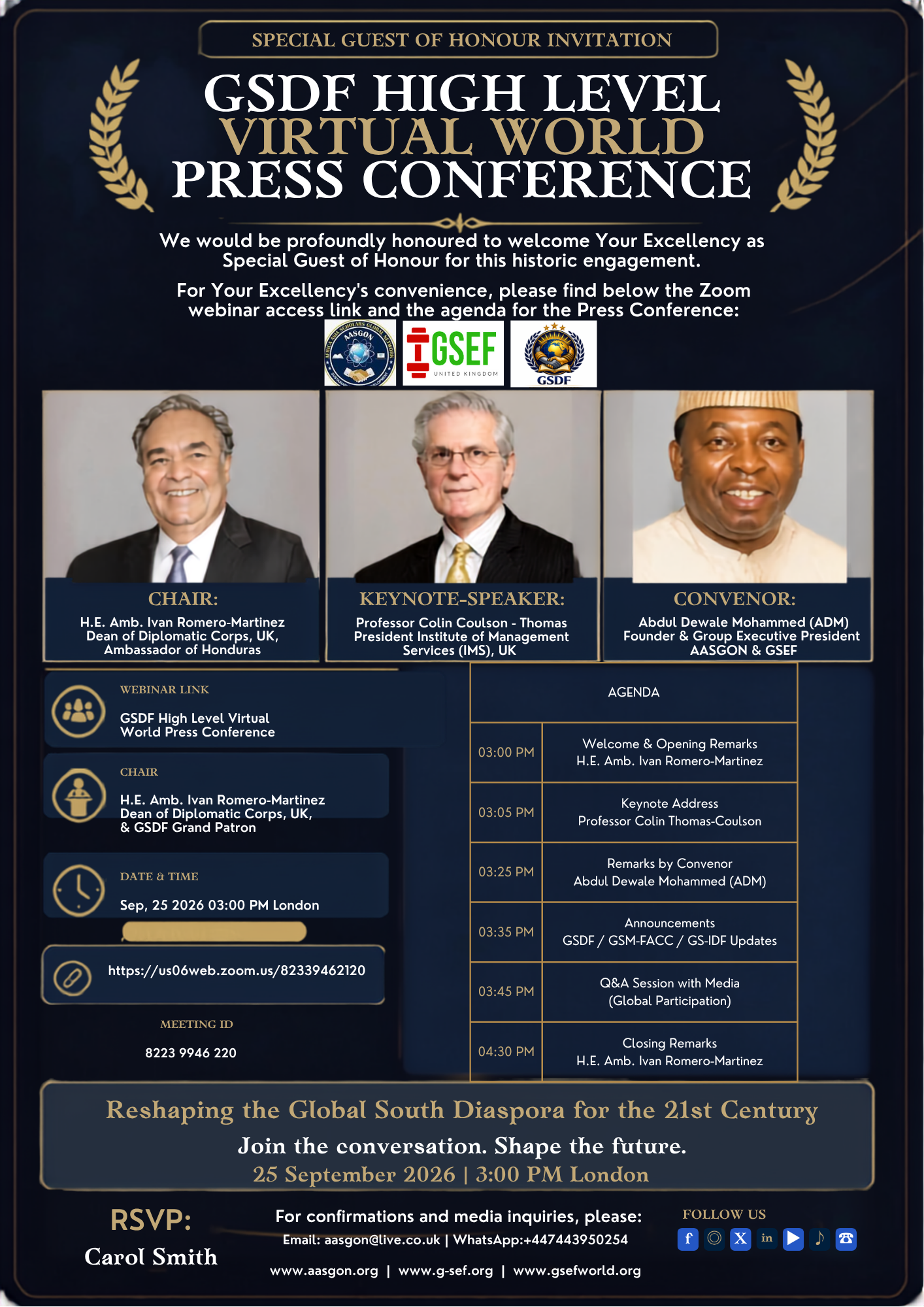
That ambition was presented through the inaugural GSDF High-Level Virtual World Press Conference on 25 September 2026, organised by the Africa Asia Scholars Global Network and the Global South Economic Forum. The materials supplied to Afridiaspo describe GSDF as part of a wider Global South Integrated Development Framework, or GS-IDF.
The central argument is straightforward: the Global South does not lack people, resources or ideas. What it often lacks is the institutional machinery capable of connecting them.
From remittances to organised participation
For decades, migrants and diaspora communities have supported households, financed education, built businesses and transferred skills across borders. But those efforts frequently remain personal, informal or disconnected from national development priorities.
GSDF proposes a more structured role. According to its organisers, diaspora communities could contribute through investment, technical expertise, professional mentorship, policy engagement, research partnerships and connections to international markets.
The distinction matters. Sending money to relatives can solve an immediate need. Building a transparent vehicle that pools capital, identifies viable projects, recruits qualified professionals and measures outcomes could have a broader effect. That is the opportunity GSDF is attempting to define.
The institutions being proposed
The GSDF presentation introduced two planned instruments: a Global South Diaspora Investment Fund and a Global South Human Resource Development Centre. The first is intended to mobilise investment; the second is designed to connect skills, knowledge and professional capacity to development needs.
These are presented as parts of the larger GS-IDF ecosystem, which the organisers say would connect policy, universities, research, engineering, renewable energy, enterprise, media and diaspora expertise.
Among the institutions identified in the supplied framework are the Global South Universities Association, the Global South Engineers Association, the Global South Solar Energy Association, the Global South Media Association, the Global South Chambers of Commerce, Industries, Mines and Agriculture, GSDF and the Commonwealth Alliance of Professional Seniors.
The proposed direction is a move from aid to investment, then to partnership and eventually co-development. In other words, the diaspora would not be treated only as a source of emergency money or charitable support, but as a long-term development partner.
The strongest idea—and the biggest test
The strongest part of the GSDF proposition is its recognition of fragmentation. A scientist in London, an engineer in Toronto, an entrepreneur in Accra and a policy specialist in Washington may all want to contribute, but good intentions alone do not create a functioning project pipeline.
A credible system would need to connect qualified people with specific needs, match investment with investable projects, and establish who is responsible when plans fail.
That is also where GSDF will face its biggest test. The submitted material sets out a broad vision, but a vision is not yet proof of execution. Before people commit money, organisations or professional reputations, the proposed investment and human-resource structures will need clear answers on governance, legal jurisdiction, capitalisation, project selection, risk management, financial reporting, conflicts of interest and independent oversight.
The public will also need to know who can participate, how projects will be evaluated, what protections investors will receive, and how success will be measured beyond conferences and announcements.
Why the next stage matters
The framework is expected to receive another public platform at the Global South Ministers, Farmers, Academia and Chambers of Commerce Summit and Expo, scheduled for 16–18 October 2026 at the World Trade Centre in Mumbai.
That summit is designed to bring together four groups that are often separated in development planning: policymakers, practitioners, knowledge producers and businesses. Organisers describe the intended cycle as policy, practice, knowledge, review and implementation.
If that model works, diaspora participation would not sit outside development policy. It would be connected to the people designing policy, the sectors implementing it, the institutions producing knowledge and the businesses responsible for bringing ideas to market.
A proposal worth watching carefully
GSDF is asking an important question: what would happen if diaspora communities were organised not only around identity and remittances, but around accountable institutions capable of moving money, knowledge and influence toward measurable development goals?
The answer will depend less on the scale of the language and more on the quality of the structure. The next phase must show how the proposed funds, centres and partnerships will operate in practice.
For Africans and other Global South communities abroad, the opportunity is significant. So is the responsibility to demand transparency before enthusiasm becomes commitment.
This feature was developed from materials submitted to Afridiaspo by AASGON/GSEF and cross-checked against publicly available information from the AASGON website, the Global South Economic Forum, and public reporting on the GSDF launch and GSM-FACC Summit. The investment fund, human-resource centre and wider framework are described as proposed or emerging initiatives unless otherwise stated.
Global South Diaspora Foundation Wants to Turn Diaspora Power Into Development Infrastructure