GULF AIRSPACE DISRUPTIONS FROM IRAN WAR HITS SEYCHELLES TOURISM
— Mary Ene
The ongoing war between the United States, Israel, and Iran has dealt a devastating blow to Seychelles tourism, with visitor numbers plunging 37% in March 2026 compared to the same period last year. The collapse of Gulf aviation hubs — including Dubai, Doha, and Abu Dhabi — has cut off the Indian O…
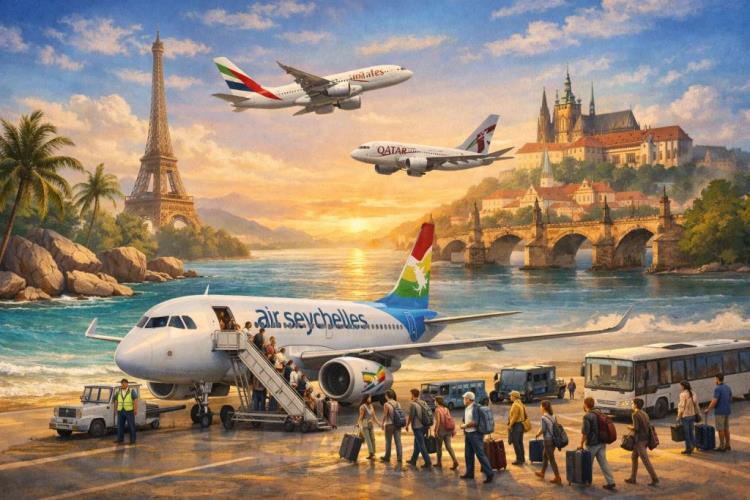
War in the Middle East has reached the beaches of the Seychelles not through bombs or conflict, but through the silent devastation of empty skies and cancelled flights that have shattered one of Africa's most tourism-dependent economies.
The numbers are stark. The total number of visitors to the Indian Ocean island dropped to 23,746 in March 2026 a 37% year-on-year slump and the lowest monthly figure since March 2021, when the country's tourism industry was on its knees due to the Covid-19 pandemic. For a small island nation whose economy runs almost entirely on tourism, this is not a statistic it is an emergency.
The root cause lies thousands of kilometres away. Airspace closures and restrictions led to 37,000 flight cancellations from February 28 to March 8 alone, according to aviation analytics firm Cirium. The UAE briefly instituted a total closure of its airspace, citing rapidly evolving regional security developments, and Dubai International Airport normally the world's busiest was forced to suspend flights after a drone attack on a nearby fuel depot. With Gulf hubs effectively paralysed, the intricate web of connecting flights that brought tourists from Europe, Asia and beyond to Seychelles simply collapsed overnight.
The scale of the disruption to global aviation has been unprecedented in the post-pandemic era. Over 46,000 flights were cancelled in the first two weeks of the conflict, according to Cirium.
EUROCONTROL reported a 59% reduction in daily flights between Europe and the Middle East, down from around 2,000 to roughly 800. Oxford Economics estimated that inbound arrivals to the Middle East could fall by between 11% and 27% year-on-year in 2026, depending on how long disruptions persist. For Seychelles, which relied heavily on Emirates, Qatar Airways and Etihad to carry European tourists through Gulf hubs, the impact was immediate and severe.
Seychelles did not wait passively for the crisis to pass. Faced with disruptions to traditional transit routes, the country acted within days: Air Seychelles wet-leased aircraft from Etihad Airways to maintain long-haul connectivity to Paris and Rome, structuring flights to bypass Middle Eastern airspace entirely.
Additional capacity was supported by Kenya Airways, and European leisure airlines such as Condor and Discover Airlines rapidly expanded alternative routes to the holiday island. The initiative created a new travel corridor that kept the destination accessible even as the Gulf burned.
Air Seychelles went further, launching a new twice-weekly service connecting Seychelles to Rome Fiumicino, operating on Wednesdays and Saturdays using the airline's Airbus A320neo aircraft with a short technical stop along the route. Italy has long been one of Seychelles' most important tourism source markets, consistently contributing a significant share of annual visitor arrivals. The Rome launch was not a commercial decision born of ambition it was a lifeline engineered under pressure.
The wider industry context is equally sobering. According to the World Travel and Tourism Council, the Middle East region was losing approximately $600 million a day in tourism revenue at the height of the disruption. Gulf airlines Emirates, flydubai and Etihad had been operating a limited number of flights mostly to repatriate stranded passengers, with the world watching in disbelief as Dubai International Airport which processes roughly 14% of global passenger traffic ground to a near-halt. Paul Charles, CEO of luxury travel consultancy PC Agency, described it as "pretty well the biggest shutdown we've seen certainly since the COVID pandemic."
On April 7, 2026, the US and Iran agreed to a two-week ceasefire, and there have been cautious signs of recovery. Dubai International Airport was operating at roughly 53% capacity at the time of writing the highest since the conflict began with Emirates running over 150 daily departures. Doha's Hamad International was at 35–40% capacity.
However, airspace restrictions remained in place across Iran, Iraq, Kuwait, Bahrain and Syria. Airlines, scarred by the volatility, were holding their flight suspensions in place, with Lufthansa Group suspending select Gulf routes through May and others through October 2026. The industry's collective message was clear: a two-week ceasefire is not the same as stability.
The Seychelles response has emerged as a case study in crisis management for small island states. Industry observers say the initiative may set a new benchmark for destinations that have historically depended on Gulf hub connectivity.
But for the tourism operators, hotel workers and boat charter businesses of the Seychelles archipelago, no amount of industry praise compensates for a lost peak season. The March numbers tell the story of a paradise caught in the crossfire of a war it had no part in — and fighting back with every plane it could find.
GULF AIRSPACE DISRUPTIONS FROM IRAN WAR HITS SEYCHELLES TOURISM