HEIFER INTERNATIONAL LAUNCHES PROJECT TO STRENGTHEN FEED AND FODDER SYSTEMS IN KENYA'S DAIRY SECTOR
— Mary Ene
Heifer International Kenya has launched the Transforming Yield through Feed and Fodder Access in Dairy (TYFFAD) project, a four-year initiative targeting more than 50,000 smallholder farmers across seven key dairy-producing counties in Kenya. The project addresses one of the sector's most persisten…
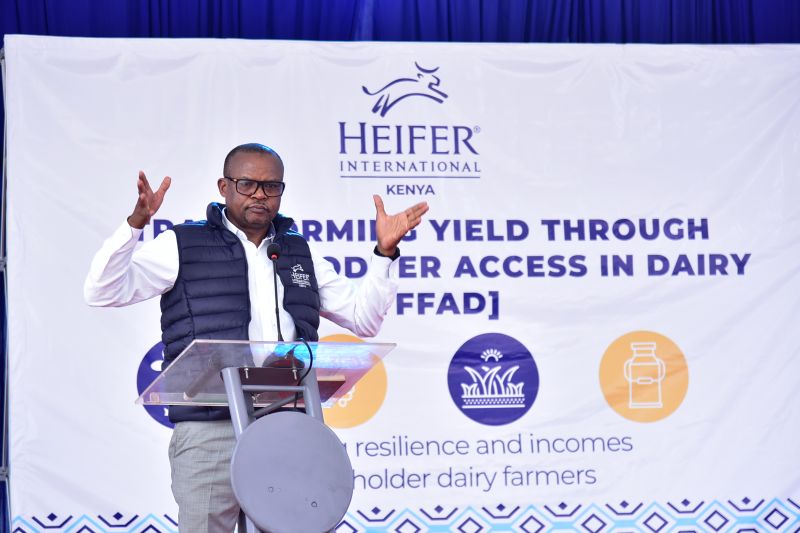
Kenya's dairy sector feeds millions, sustains over 1.8 million smallholder households, and contributes nearly half of the country's livestock GDP yet it is being quietly throttled by one fundamental problem: farmers cannot reliably feed their cows.
Heifer International Kenya has launched the Transforming Yield through Feed and Fodder Access in Dairy project known by its acronym, TYFFAD a four-year initiative expected to benefit more than 50,000 smallholder farmers by addressing the systemic feed and fodder constraints that limit milk yields across the country. The project will be implemented in seven key dairy-producing counties: Uasin Gishu, Nandi, Elgeyo Marakwet, Trans Nzoia, Laikipia, Nakuru, Kiambu and Narok. A central feature of the project is its focus on women and youth, who contribute significantly to Kenya's dairy sector but remain largely excluded from land ownership, credit facilities and market opportunities.
The scale of the challenge being addressed is formidable. Kenya's dairy sector supports more than 1.8 million smallholder households and contributes 4.5% of national GDP, 14% of agricultural GDP, and 44% of livestock GDP. Despite this enormous economic footprint, productivity remains far below potential. Average yields sit at approximately 7.5 litres per cow per day — a figure that reflects persistent failures in the feed and fodder supply chain rather than any inherent limitation of the animals or the farmers. The gap between actual and achievable production represents not just lost milk but lost income, lost nutrition, and lost livelihoods for millions of Kenyans.
The TYFFAD project takes aim at the full length of the feed and fodder value chain, from how feed is produced and stored to how it reaches farmers and markets. It will support farmers to better preserve feed, access quality inputs, and connect to more reliable commercial markets. The project will also explore practical financing options, expand access to mechanisation, and deploy digital tools to deliver timely advisory services to farmers. These digital tools are particularly significant: in a sector where a week of feed shortage can wipe out months of production gains, real-time information and accessible credit could be transformative.
Government endorsement was unequivocal at the launch. Speaking on behalf of the Principal Secretary of the State Department of Livestock Development, Ms Midina Yattani affirmed that feed and fodder are the most critical constraints to improving dairy productivity in Kenya. "The majority of milk is produced by smallholder farmers operating at low levels of productivity," she said. "The root cause is the lack of adequate and quality feed. Addressing this gap is essential to improving farmer incomes, strengthening resilience, and unlocking the full potential of the dairy sector." Her remarks reflected a government that has identified the feed systems problem not as a technical detail but as a structural development emergency.
The project's equity focus sets it apart from conventional agricultural interventions. Women form the backbone of Kenya's smallholder dairy economy, yet they are systematically denied the land titles, loan guarantees and market relationships that would allow them to grow their operations. TYFFAD's explicit commitment to creating more opportunities for women and youth and for emerging agribusinesses built around feed supply signals a recognition that productivity gains cannot be sustained without also addressing the structural barriers that hold half the sector back.
The government has also outlined parallel institutional investments to support the sector. These include the establishment of a multi-stakeholder platform for feed coordination, development of the Livestock Bill, and investments in research through the Kenya Agricultural and Livestock Research Organisation to improve access to quality, climate-resilient fodder varieties. Together, these measures signal that TYFFAD is not designed as a standalone intervention but as part of a longer-term national dairy strategy — one that sees feed systems as the foundational investment required before any other improvement can take hold.
Heifer International has deep roots in East African dairy development, having previously led programmes that have transformed the lives of hundreds of thousands of farming families across Kenya, Uganda and Tanzania. Its broader Kenya mission aims to help 625,000 households achieve a sustainable living income by 2030 through the transformation of agricultural value chains. TYFFAD represents the newest and most targeted expression of that ambition focused on the one constraint that, if solved, could unlock the full productive potential of Kenya's most important agricultural subsector.
Heifer International noted at the launch that lasting progress in the dairy sector will depend on continued collaboration among government, private sector players, research institutions and farmer organisations. That coalition-building approach rather than a top-down delivery model reflects a hard-won understanding that the dairy systems problem in Kenya is too deep and too widespread to be solved by any single actor working alone.
HEIFER INTERNATIONAL LAUNCHES PROJECT TO STRENGTHEN FEED AND FODDER SYSTEMS IN KENYA'S DAIRY SECTOR