MAXHOSA Took South African Luxury to Paris—and Kept the Work at Home
— Afridiaspo Editorial
On September 28, 2026, Laduma Ngxokolo's MAXHOSA AFRICA showcased Xhosa-rooted design and South African manufacturing at a Paris runway show.
PARIS — The most important thing about MAXHOSA AFRICA’s latest Paris runway was not that Laduma Ngxokolo had finally entered a gilded room in the French capital. It was that the clothes arrived there carrying an African supply chain with them.
On September 28, 2026, Ngxokolo presented a full runway show at the residence of South Africa’s ambassador to France. Reuters described MAXHOSA as the first South African brand to stage a complete show on the official Paris Fashion Week calendar. Models moved through the residence in pleated knits, checkerboard tailoring and garments carrying the names of African countries. Kenyan artist Cyrus Kabiru supplied sculptural eyewear made from discarded materials; South African musician Sjava supplied the soundtrack.
The spectacle mattered. But the industrial detail mattered more: MAXHOSA says its knitwear is made in factories it owns in Johannesburg and East London, using wool sourced in the Eastern Cape. Paris supplied the global stage. Much of the value creation remained at home.
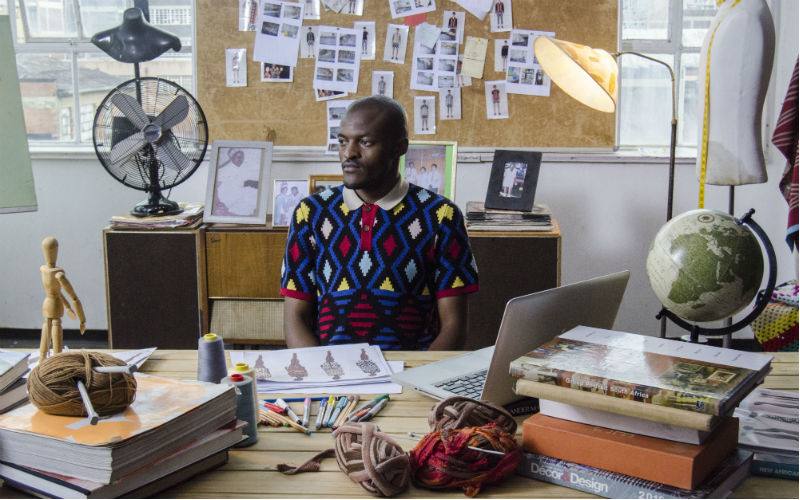
Featured-image credit: Mathiba Molefe / Brand South Africa. Authentic photograph, republished with source credit under Brand South Africa’s material-use policy.
A Paris milestone with a necessary distinction
MAXHOSA did not arrive in Paris from nowhere. The label had appeared on the official calendar before. In a 2024 interview with Le Monde, Ngxokolo described that year as the brand’s first official Paris Fashion Week listing. Vogue reported in March 2026 that MAXHOSA was then the only African brand on the official calendar.
What changed on September 28 was scale and format. Reuters reported the event as the first full runway show by a South African brand during the official calendar. That wording matters: it avoids erasing MAXHOSA’s earlier Paris work while still recognizing the size of this particular step.
| Year | Milestone | Why it matters |
|---|---|---|
| 2010–11 | Ngxokolo develops Xhosa-inspired knitwear from his textile-design work and builds the label that becomes MAXHOSA AFRICA. | The original design problem was local: modern knitwear for amakrwala, young Xhosa men returning from initiation. |
| 2018 | The company brings knit manufacturing in-house in Johannesburg, according to Ngxokolo’s later account. | Production control turns cultural authorship into a business and employment question, not only an aesthetic one. |
| 2024 | MAXHOSA joins the official Paris Fashion Week calendar and opens a New York store. | The label gains visibility in two global luxury capitals while retaining a South African identity. |
| September 2026 | A full official-calendar runway is staged at the South African ambassador’s residence in Paris. | The show links runway prestige to African materials, factories, music and collaboration. |
The design language began with a real community
Ngxokolo’s work is often reduced to “bold African prints,” a phrase broad enough to flatten the very specificity that makes MAXHOSA distinctive. His visual language grew from Xhosa beadwork, geometry and colour, interpreted through knitwear rather than copied as costume.
The early concept addressed the clothing worn by amakrwala after initiation. That is an unusually precise starting point for a luxury brand: a contemporary wardrobe rooted in a particular transition, community and need. Over time, the label expanded into womenswear, accessories, home products and a wider fashion house, while its repeating geometries became recognizable far beyond South Africa.
In a Brand South Africa interview, Ngxokolo described his ambition as translating culture into a modern context and proving that South African culture could belong in high fashion. Years later, the Paris show made that argument in physical form.

Pan-Africanism was built into the show
The September collection did not treat pan-Africanism as a slogan pasted onto a press release. It appeared in the construction of the event. Country names moved across garments. Kabiru’s waste-built eyewear brought a Kenyan artistic practice into the styling. Sjava’s music made the soundscape unmistakably South African. The venue itself—the ambassador’s residence—turned the runway into a cultural and diplomatic room as well as a commercial one.
Ngxokolo told journalists that he wanted to present an Africa defined by economic possibility, beauty and business success. That is an aspiration, not a description of conditions across the continent. The collection was most persuasive where it showed what such an economy might require: designers collaborating across borders, raw materials becoming finished luxury goods closer to their source, and African companies controlling more of their own manufacturing and brand story.
There was also a limit. Ngxokolo said resource constraints prevented him from including more African designers. That admission keeps the event from becoming an easy triumphal narrative. Representation at Paris Fashion Week remains expensive, selective and difficult to scale.
The factories are the sharper story
African creativity has long travelled globally while production value, intellectual-property control and retail margin accumulated elsewhere. MAXHOSA’s model pushes against that familiar pattern. The company’s ownership of knitting facilities in Johannesburg and East London gives it greater control over quality, timing and the translation of designs into finished garments.
Ngxokolo told Le Monde in 2024 that bringing manufacturing in-house had improved margins and control. He said the longer-term ambition was to command still more of the chain, including yarn made from South African wool and mohair. Reuters reported that the wool used in the 2026 knitwear came from the Eastern Cape, where the East London factory is located.
This does not automatically make every garment sustainable, every job secure or every business choice beyond scrutiny. Those claims require evidence. But it does make the central economic proposition visible: African luxury can mean more than African inspiration. It can include African design ownership, African inputs, African production and African wages.
What to watch after Paris
- Production depth: How much of MAXHOSA’s supply chain can remain or become South African as international demand grows?
- Worker outcomes: Will factory expansion produce durable skilled jobs and training pathways?
- Continental collaboration: Can future shows include more African designers and makers without reducing them to supporting decoration?
- Market balance: Can the brand grow abroad without treating African customers as an afterthought?
- Cultural stewardship: How will MAXHOSA protect a design language rooted in community while operating in a global copying economy?
Why this matters to Africans and the diaspora
For diaspora audiences, MAXHOSA’s appeal is not difficult to understand. Its clothes make heritage visible without freezing it in the past. They can be worn in Johannesburg, Lagos, London, Minneapolis or New York without asking the wearer to choose between modernity and cultural memory.
But the larger lesson is about ownership. Global recognition is useful when it returns leverage to the place that generated the work. A Paris runway can attract buyers, press and partnerships. The deeper win is converting that attention into factories, apprenticeships, export capacity, protected intellectual property and creative confidence at home.
That is why this show was bigger than a “first.” Firsts are ceremonial; systems endure. MAXHOSA’s next challenge is not merely to be welcomed back to Paris. It is to prove that an African luxury house can expand globally while keeping authorship, skill and a meaningful share of the value chain on the continent.
Sources and further reading
- Reuters, September 28, 2026: MAXHOSA AFRICA brings pan-Africanism to Paris Fashion Week
- MAXHOSA AFRICA official site and September 28 Paris Fashion Week notice
- Le Monde, October 1, 2024: Interview with Laduma Ngxokolo
- Vogue Business, November 4, 2022: MAXHOSA’s luxury and retail strategy
- United Nations Global Africa Business Initiative: Laduma Ngxokolo profile
- Brand South Africa: Interview and authentic photography
- Brand South Africa material-use policy
MAXHOSA Took South African Luxury to Paris—and Kept the Work at Home