Men of the Week: Five West African Storytellers Building Beyond the Screen
— Afridiaspo Editorial Team
Afridiaspo profiles Kunle Afolayan, Blitz Bazawule, Alain Gomis, Djimon Hounsou and Idris Elba—five men expanding West African storytelling.
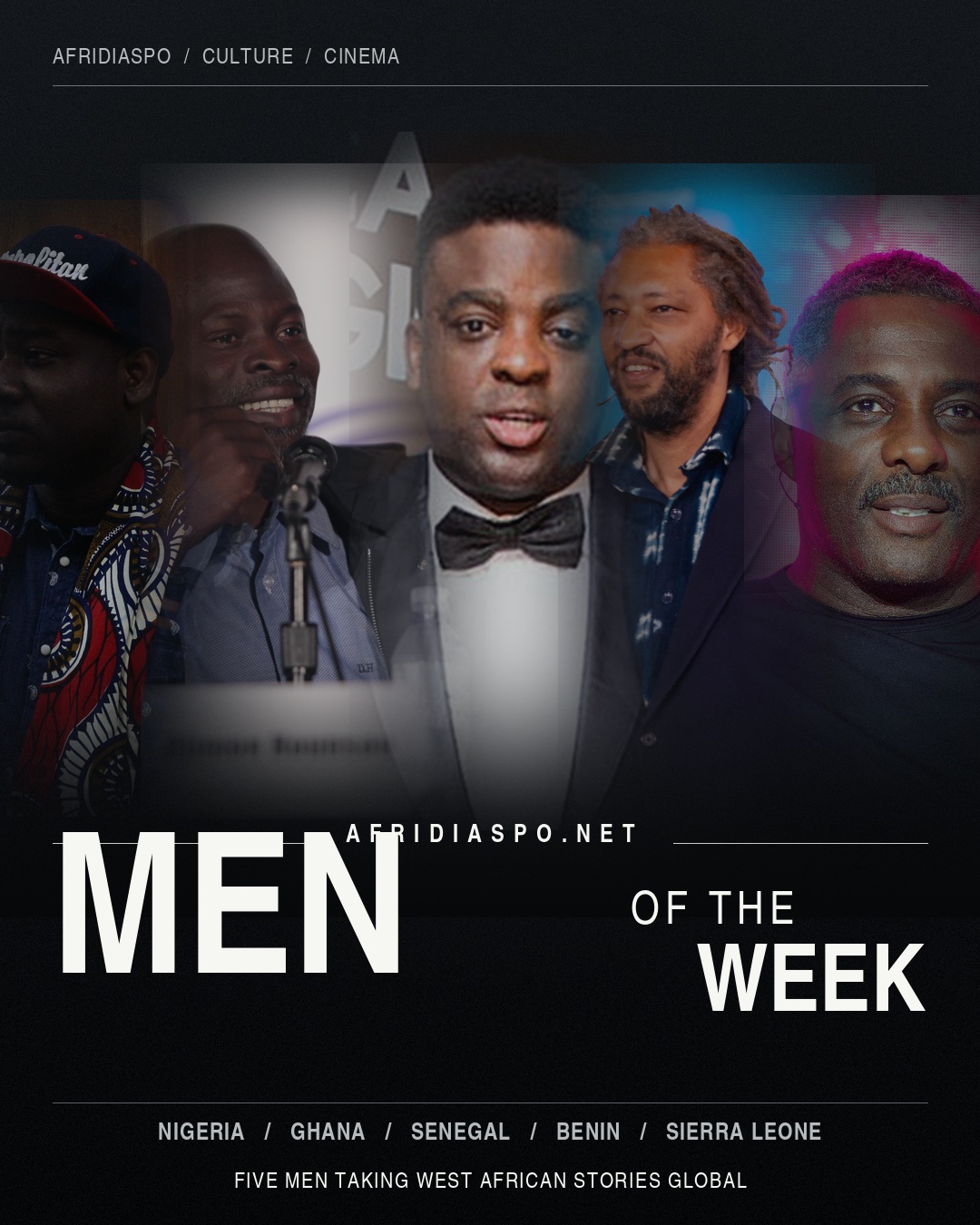
From a film village in Oyo State to a Berlinale competition premiere, this week’s five men show what happens when West African imagination is matched with ownership, infrastructure and global reach.
West African cinema has never lacked stories. The harder question has been who gets to finance them, frame them, distribute them and build the institutions that allow the next generation to keep creating. Afridiaspo’s first Men of the Week edition recognises five men connected to five different West African countries who are answering that question in distinct ways.
They work across Nollywood, independent African cinema, Hollywood, music, cultural advocacy and creative infrastructure. What connects them is not fame alone. Each man is using his position to widen the space available for African stories—and to insist that African identity can be specific, complex and globally legible without being diluted.
Kunle Afolayan — Nigeria
Kunle Afolayan’s contribution to Nigerian cinema is no longer measured only by the films he directs. It is also visible in what he is building around them.
For two decades, Afolayan has worked across acting, directing and producing, with films including The Figurine, October 1, Phone Swap, Citation, Swallow and Aníkúlápó. His work is commercially ambitious, visually polished and grounded in Nigerian history, language and social life. He has repeatedly shown that stories rooted in Yoruba culture can travel far without being stripped of their identity.
The larger argument now sits in Igbojaye, Oyo State. KAP Film Village & Resort officially opened on April 12, 2025 as a combined production, training, hospitality and cultural destination. In 2026, Afolayan said he had invested more than ₦8 billion of his own money in the development, while also speaking openly about the electricity and operating-cost pressures facing the facility. That honesty matters: creative infrastructure is not a glamour project. It is land, power, training, maintenance and long-term capital.
Afolayan earns this week’s recognition because he is moving beyond making successful films to building a place where more films can be made. For Nigerian cinema, that shift—from project to institution—is the real legacy play.
Blitz Bazawule — Ghana
Blitz Bazawule has built a career by refusing to stay inside one creative lane. Born in Accra, he has worked as a musician, visual artist, novelist, screenwriter and film director. That multidisciplinary background is not decoration; it shapes the rhythm, colour and interior life of his films.
His feature debut, The Burial of Kojo, brought a dreamlike Ghanaian story to an international audience. He later co-directed Beyoncé’s visual album Black Is King before taking on the 2023 screen musical The Color Purple. The scale changed, but his central interest did not: how Black people imagine themselves when the camera is not treating them as a problem to be explained.
In The Color Purple, Bazawule expanded Celie’s inner world through fantasy, music and movement. In an interview about the production, he described the importance of giving the character an imagination, an approach that helped turn a familiar story into a more intimate study of survival and self-possession. His journey from an independently produced Ghanaian feature to a major Warner Bros. release is significant, but the more important point is that the Ghanaian eye did not disappear when the budget grew.
Bazawule represents a form of global African authorship that is confident enough to work across continents and genres. He does not ask African creativity to choose between local memory and international scale.
Alain Gomis — Senegal
Alain Gomis makes cinema across borders, but his work never treats the diaspora as a vague idea. It is felt in bodies, languages, rituals, absences and the emotional distance between one home and another.
The French-Senegalese filmmaker returned to the Berlin International Film Festival’s main competition in February 2026 with Dao. According to the official Berlinale programme, the film moves between a wedding in France and a memorial ceremony in Guinea-Bissau, bringing family history, migration and ritual into the same cinematic space. It follows earlier work including Tey, Félicité and the documentary Rewind & Play.
Gomis also founded the Yennenga Centre in Dakar, extending his work beyond directing into the development of African cinema and creative exchange. That combination matters. Festival recognition can elevate one filmmaker; institutions can help an entire film culture retain knowledge, develop talent and create its own conditions for work.
His cinema is patient and unafraid of complexity. It allows African and diasporic lives to remain layered instead of forcing them into a single explanatory frame. At a moment when platforms often reward stories that can be reduced to a quick premise, Gomis keeps making films that trust the audience to stay, listen and feel.
Djimon Hounsou — Benin
Djimon Hounsou’s screen presence has carried him from Cotonou to some of the biggest film franchises in the world, but his most important work may be the bridge he is trying to build beyond Hollywood.
Born in Benin, Hounsou became internationally recognised through roles in films including Amistad, In America and Blood Diamond. The latter two performances earned him Academy Award nominations for supporting actor. He later moved between independent drama and global franchises including the Marvel Cinematic Universe, A Quiet Place Part II and Rebel Moon.
His public work through the Djimon Hounsou Foundation brings a different kind of story into focus. The foundation’s stated mission is to reconnect the African diaspora with the continent and to confront the historic wounds created by slavery. Its cultural programmes frame history not as a distant subject but as something people can encounter through place, memory and shared experience.
Hounsou belongs in this edition because he has used a highly visible international career to ask a deeper question: what does return mean for people whose histories were violently separated? His answer is not only symbolic representation on screen. It is cultural reconnection, historical education and a more direct relationship between Africa and its diaspora.
Idris Elba — Sierra Leone
Idris Elba was born in London to a Sierra Leonean father and a Ghanaian mother. For this edition, Afridiaspo recognises his Sierra Leonean heritage and the increasingly concrete way he has connected his global career to Africa’s creative future.
Elba is already established across acting, producing, directing and music. What makes his current direction especially relevant is his insistence that African storytelling needs more than talent; it needs studios, cinemas, finance and distribution. In 2025, he spoke publicly about building an “African Odeon”—a cinema network designed to expand theatrical access across the continent. He has also discussed spending more time in Accra, Freetown and Zanzibar while supporting film-industry development and locally owned storytelling.
That ambition is becoming visible in his screen work. His production interests have expanded through Green Door Pictures and 22Summers, while projects linked to Ghana and other African locations point toward a career increasingly shaped by where creative capacity can be built, not only where a finished film can be sold.
Elba’s Sierra Leonean connection is not an accessory to his identity. He has described Sierra Leone as his father’s country and his bloodline. The opportunity now is to convert that attachment—and his access to global capital and audiences—into durable pathways for African filmmakers. If he succeeds, the impact will be measured not simply in one studio or one film, but in who gets trained, financed, screened and paid.
Why these five, and why now
Kunle Afolayan is building physical production infrastructure. Blitz Bazawule is proving that a Ghanaian visual language can survive the leap to studio scale. Alain Gomis is protecting the complexity of diasporic cinema while investing in creative development. Djimon Hounsou is turning visibility into cultural reconnection. Idris Elba is arguing for the cinemas, studios and financial systems African stories need to reach their own audiences.
Together, they offer a larger definition of influence. It is not simply being seen. It is building the conditions that allow other people to create, remember and be seen after you.
Afridiaspo Men of the Week: Kunle Afolayan (Nigeria), Blitz Bazawule (Ghana), Alain Gomis (Senegal), Djimon Hounsou (Benin) and Idris Elba (Sierra Leonean heritage).
Image credits: Kunle Afolayan photographed by Ameyaw Debrah, CC BY 3.0; Blitz Bazawule photographed by Coup d’Oreille, CC BY-SA 2.0; Alain Gomis photographed by Celestinesucess/WikiPortraits, CC BY-SA 4.0; Djimon Hounsou photographed by Gage Skidmore, CC BY-SA 2.0; Idris Elba photographed by Amy Martin Photography/WikiPortraits, CC BY-SA 4.0. Images were cropped, layered and colour-toned for the Afridiaspo cover. Composite distributed under CC BY-SA 4.0.
Reporting sources: KAP Hub; KAP Film & Television Academy; Berlin International Film Festival; Djimon Hounsou Foundation; Warner Bros./The Color Purple production reporting; and public statements by Idris Elba on African film infrastructure. All links were checked on October 12, 2026.
Men of the Week: Five West African Storytellers Building Beyond the Screen