Mozambique: ‘Notícias’ aims to remain a cornerstone of national journalism after 100 years on the newsstands
— Mary Ene
Notícias, Mozambique’s oldest daily founded in 1926, is marking 100 years by positioning itself as a training ground for journalists while cautiously expanding into publishing, printing, and multimedia despite operating solely on its own funding. The paper aims to adapt to a digital, social media–d…
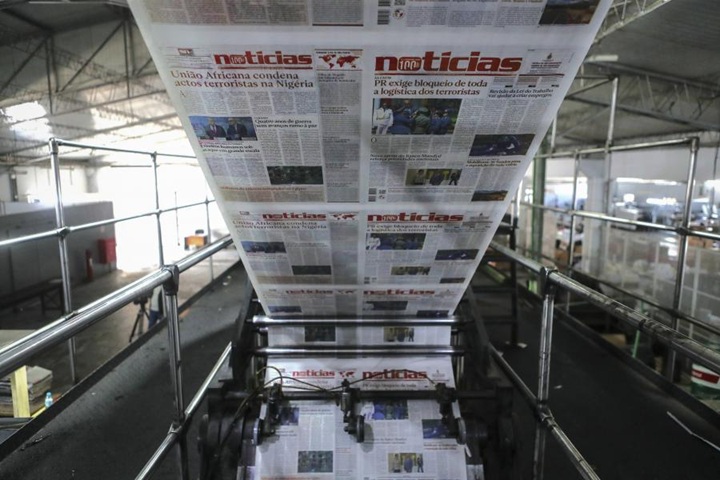
Mozambique: ‘Notícias’ aims to remain a cornerstone of national journalism after 1
The newspaper Notícias, the oldest daily in Mozambique, wants to continue being a school of communication as it celebrates 100 years, focusing on improving working conditions for journalists and on the publisher and printing company’s project to thrive in the market.
“I think it is possible to look at ‘Notícias’ from this perspective of being a seed for various things that have emerged in the field of communication. But there is one perspective that is never lost, which is that of being a school where the media, in some way, has been invented and grown,” says Júlio Manjate, chairman of the board of the Sociedade do Notícias, in an interview with the Lusa news agency.
Based in Maputo and with around 150 journalists across the country, Notícias was first published on 15 April 1926, created by the Portuguese Manuel Simões Vaz. From the 1980s onwards, it began to incorporate products such as the weekly Domingo and Desafio, as well as its printing unit with facilities in Maputo province, southern Mozambique.
Over 100 years, the newspaper has operated with the perspective of contributing to the public good through responsible reporting, says the administrator: “It has functioned as a school, not only for training professionals but also to inspire these new business areas and fields of intervention.”
Three years ago, it began to focus on providing publishing services, having already published two works, with four more in the pipeline. Manjate explains that the aim is not to “take steps bigger than the leg,” despite investing in new authors.
He adds that the company continues to study the market, but always approaches the new business “with caution.”
“First, it was necessary to create a base, and we are somewhat in this exercise of trying to create a solid foundation, so that things can grow. We need human resources dedicated solely to working, and this has financial implications,” he explains.
“We must not lose sight of the idea that, as we enter a new business area, we cannot rush things. It is always better to act with some prudence and recognise that there are people who have been working in the field for much longer, and we should always seek to learn from that. It is a very interesting brand; no one refuses to collaborate with us,” Manjate adds.
To strengthen its activities as a publisher, Notícias intends to combine this service with its printing facilities in the city of Matola, on the outskirts of Maputo.
Reaching 100 years of existence, adapting the daily newspaper through the various moments of history while maintaining its philosophy of “responsible work,” has been one of the greatest challenges.
“There were times when the newspaper’s role was to provide public education. There were times when it began civic education to help people accept multiparty politics, and this was done with due mastery. And, at this moment, for example, we are doing work that is public education to help people understand that we are in a phase of economic recovery, and we try to adjust according to the main messages,” says the chairman of the board.
Another challenge for the company has been training journalists to develop greater skills in reading and interpreting the various phenomena around them, particularly with the advent of new technology.
“The newspaper Notícias operates on its own resources. Everything it does — buying paper, printing, paying journalists, sending journalists on assignments — is funded independently. We are not a public company that would probably have a programme contract with the State to receive subsidies. Everything that has been done is based on our own resources, so securing funding to maintain, grow, and develop is also another challenge,” he says.
Currently, the goal is also to improve journalists’ salaries to a slightly “more dignified” level, with the company indicating that it wants to move into multimedia, needing only to find a strategy to fit the newspaper into a digital world dominated by social networks without losing its identity and responsibility in reporting.
Manjate further states that the current challenge is to improve the technical conditions for journalists, providing them with tools for research, dissemination, and content distribution, and ensuring that all are capable of operating graphic editing programmes to force them to reduce the number of characters in each text.
Source: Lusa