Nigeria Won Its Place. Visas Kept Its Flag Football Teams Home
— Afridiaspo Sports Desk
Nigeria’s flag-football teams earned a world-stage debut, but visa delays kept them from Düsseldorf. What happened—and what must change before LA28.
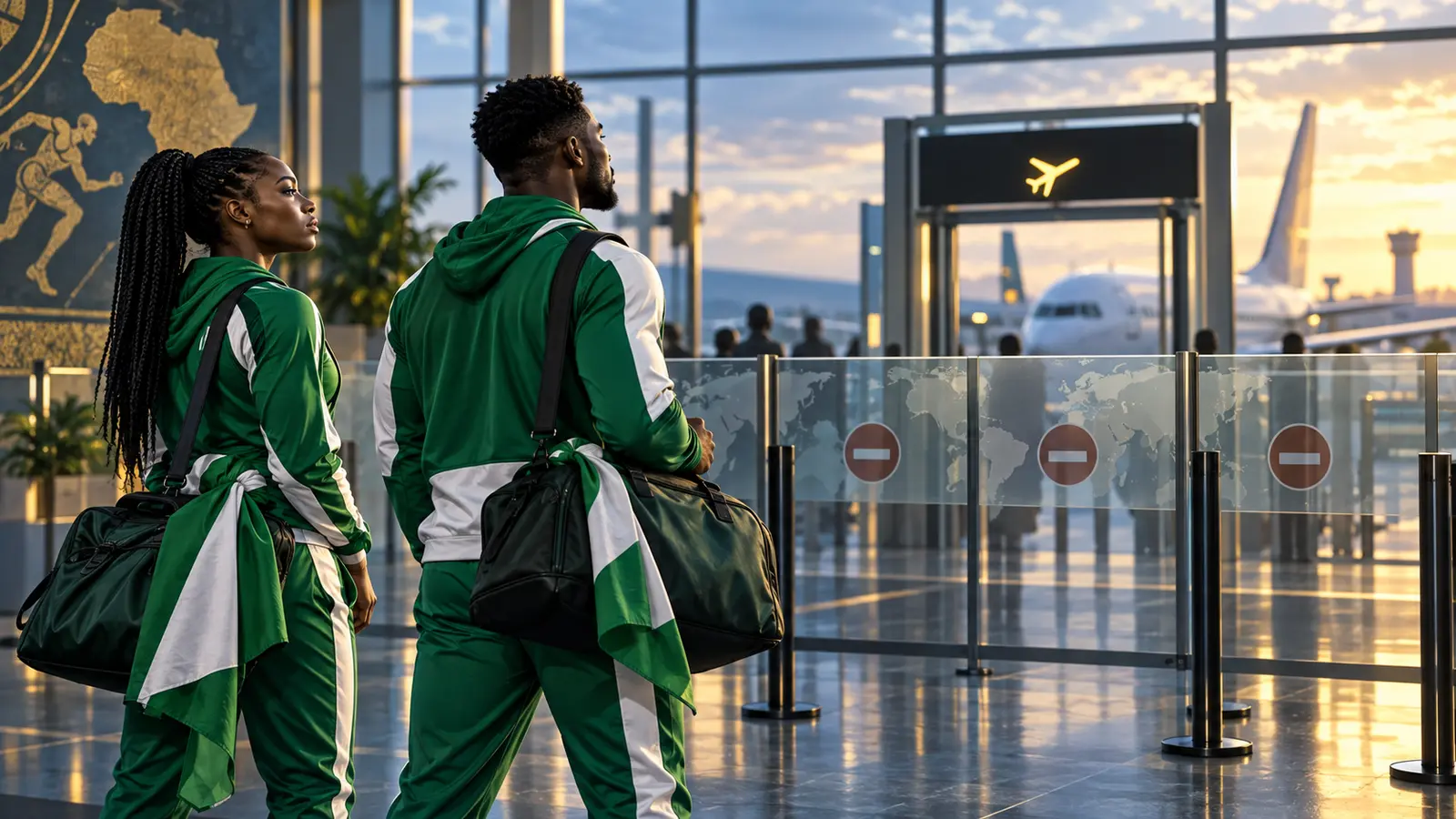
The bags were packed for history. Nigeria’s men’s and women’s flag-football teams had done the sporting work: they had won Africa’s inaugural continental championships, secured places at the 2026 world championships and prepared to carry the green and white onto the game’s largest global stage yet.
Then the journey stopped before the airport gate.
On August 10, just three days before the IFAF Flag Football World Championships opened in Düsseldorf, the International Federation of American Football, Nigeria’s National Sports Commission and the Nigerian Federation of American Football announced that the delegation’s visas would not be issued in time. Both teams withdrew. Their scheduled opponents received automatic wins.
For Nigerian athletes, it was a brutal lesson in the difference between qualifying for the world and being able to reach it. For African sport, it was something larger: a warning that talent pathways are incomplete when travel, administration and institutional support cannot keep pace with performance.
Afridiaspo key facts
- What Nigeria earned: places for its men’s and women’s teams at the 2026 IFAF Flag Football World Championships.
- What went wrong: the joint statement said the delegation did not receive the necessary visas in time to travel to Germany.
- What was lost: Nigeria’s first appearance at a senior flag-football world championship.
- What remains: a route toward the Los Angeles 2028 Olympics through the 2027 African continental competition and the subsequent Olympic qualifying series.
The achievement came first
Nigeria’s absence should not obscure how quickly its flag-football programme rose.
In June 2025, Cairo hosted the first IFAF Africa Flag Football Championships. The competition created Africa’s formal route into the 2026 world championships and placed men’s and women’s national teams on the same continental stage. Nigeria emerged as Africa’s representative in both divisions.
The breakthrough was not an isolated weekend. In July 2026, the continental championship returned in Kenya. IFAF reported that Nigeria won the women’s title while Egypt defeated Nigeria for the men’s crown. Even after the original qualification campaign, Nigeria remained one of the continent’s leading programmes in both categories.
That matters because flag football is still building its African identity. Unlike association football, the sport does not arrive with a century of clubs, academies, domestic leagues and national traditions behind it. Every national camp, school programme, coaching clinic and continental tournament is part of creating that ecosystem almost from the ground up.
Nigeria’s teams were therefore carrying more than their own medal ambitions. They were meant to provide a first measuring point for how African champions would respond to elite opposition from Europe, the Americas, Asia and Oceania.
The visa deadline that ended the trip
According to the joint statement reported on August 10, IFAF, its partners and the relevant authorities had spent the preceding 10 days trying to resolve the travel problem. They were ultimately informed that the visas would not be issued before the championship began.
The timing left organizers unable to bring in replacement teams. Nigeria’s group-stage opponents were awarded victories under the competition rules.
No public explanation established why the applications were not completed in time, so it would be irresponsible to assign motives or blame without evidence. The confirmed fact is narrower and still devastating: qualified athletes could not reach a tournament for which they had prepared because the required travel documents were unavailable before departure.
The world championships proceeded in Düsseldorf from August 13 to 16. USA Football recorded 19 participating nations from five continents. The United States won the men’s title; Canada won the women’s championship. Nigeria’s results column remained empty—not because its teams lost, but because they never took the field.
How flag football differs from the NFL game
| Feature | Flag football | Tackle football |
|---|---|---|
| Stopping a play | A defender removes a flag from the ball carrier’s belt. | A defender tackles the ball carrier to the ground. |
| Protective equipment | No heavy helmet-and-pad package is required. | Helmets, shoulder pads and other protective equipment are standard. |
| Style | Five-a-side Olympic format emphasizing speed, space, passing and agility. | Eleven-a-side game built around blocking, tackling and specialized units. |
| Access | Lower equipment demands can make new community and school programmes easier to start. | Higher equipment, facility and coaching requirements can raise entry costs. |
That accessibility is central to flag football’s African opportunity. Reuters reported that the non-contact version requires less costly equipment and offers a clearer route for women to participate. It also fits schools and community programmes that may not have the budgets or medical infrastructure required for full-contact American football.
The format is not a simplified afterthought. At elite level, it demands precise route running, rapid decision-making, spatial awareness and defensive anticipation. The ball moves quickly. With less time and less contact to disrupt a play, technical mistakes become visible immediately.
From a new African championship to an Olympic sport
The African competition was created as part of a global expansion tied to flag football’s Olympic debut at Los Angeles 2028. When IFAF announced the first continental championship, NFL Africa lead Osi Umenyiora summarized the principle plainly: “You can’t say you are a global sport and you exclude Africa.”
Umenyiora’s point is about more than representation. A truly global sport must offer credible routes to coaching, competition and qualification on every continent. It must also make sure that the teams emerging from those pathways can complete the journey.
NFL owners have approved the participation of league players at LA28, adding star power to the Olympic launch. The Games will feature men’s and women’s flag football, giving African nations a rare chance to enter a new Olympic discipline before the international hierarchy becomes fixed.
Chronology: Nigeria’s road—and the road still ahead
| Date | Milestone | Why it matters |
|---|---|---|
| April 2025 | IFAF announces Africa’s first continental flag-football championships. | Africa receives a formal world-championship pathway. |
| June 2025 | Nigeria’s men and women emerge from the inaugural Cairo event as Africa’s qualifiers. | Both teams earn historic first world-championship places. |
| July 2026 | At the next African championship in Kenya, Nigeria wins the women’s title and finishes behind Egypt in the men’s division. | The programme confirms competitive depth beyond one qualifying event. |
| August 10, 2026 | A joint statement confirms both Nigerian teams will miss Düsseldorf because visas will not arrive in time. | An administrative barrier erases the country’s world-championship debut. |
| August 13–16, 2026 | The world championships proceed with 19 nations from five continents. | Nigeria loses elite competition, ranking and development experience. |
| 2027 | The next African continental championship offers another route toward Olympic qualification. | Nigeria’s LA28 ambition remains alive, but preparation must include travel readiness as well as performance. |
The cost cannot be measured only in forfeits
A missed tournament affects more than a record book.
Players lose the chance to test themselves against world-level speed and tactics. Coaches lose film and data that would guide the next training cycle. A young federation loses visibility that can attract sponsors, facilities and new participants. Girls watching at home lose the opportunity to see Nigerian women competing in a new international sport.
There is also a rankings and credibility cost. Emerging programmes need repeated exposure to improve. When an African team misses a major event, the competitive gap can widen even if the talent gap does not.
This is why visas, travel budgets, application timelines and dedicated administrative staff are part of high-performance sport. They may not appear on the scoreboard, but they determine whether a team reaches the scoreboard at all.
What must change before the next opportunity
Nigeria’s Olympic pathway remains open. The joint statement said both teams can compete at the 2027 continental championship, where a top-two finish would advance them toward the Olympic qualifying series.
Turning that opportunity into participation requires an early, documented travel plan alongside the sporting plan:
- Start visa preparation as soon as qualification scenarios are known, not only after final rosters are selected.
- Assign clear administrative ownership for passports, invitation letters, appointments and follow-up.
- Build direct coordination among the national federation, sports authorities, IFAF and host organizers.
- Create contingency timelines for replacement athletes, delayed documents and regional travel.
- Fund travel operations as part of performance preparation, rather than treating them as separate paperwork.
Those measures cannot guarantee a visa decision. They can reduce avoidable uncertainty, surface problems earlier and give sporting bodies more time to intervene through proper channels.
The Afridiaspo takeaway
Nigeria’s flag-football teams did not fail in Düsseldorf. They were denied the chance to find out how far their preparation could carry them.
The distinction matters. African athletes are too often asked to prove themselves twice: first in competition, then against the logistical barriers that stand between qualification and participation. A global sports system cannot celebrate new African pathways while treating access to the destination as an afterthought.
The hopeful part of this story is that Nigeria’s programme remains young, competitive and alive. Its women returned to the top of Africa in 2026. Its men remained continental finalists. The Olympic door has not closed.
But the next campaign must begin with two parallel preparations: one for the field, and one for the journey. Nigeria has already shown it can win its place. The next task is making certain its champions can take it.
Sources
- International Federation of American Football: 2026 Africa championship results
- AS: Joint-statement details on Nigeria’s withdrawal and Olympic pathway
- USA Football: 2026 world championship dates, participation and results
- Reuters: IFAF’s African expansion and the road to LA28
- Reuters: NFL players cleared to compete in Olympic flag football
Nigeria Won Its Place. Visas Kept Its Flag Football Teams Home