Odell Beckham Jr.’s Homecoming Ended Without a Catch
— Afridiaspo Editorial
Why the Giants released Odell Beckham Jr. after three games, what the brief return says about NFL roster economics, and how his legacy endures.
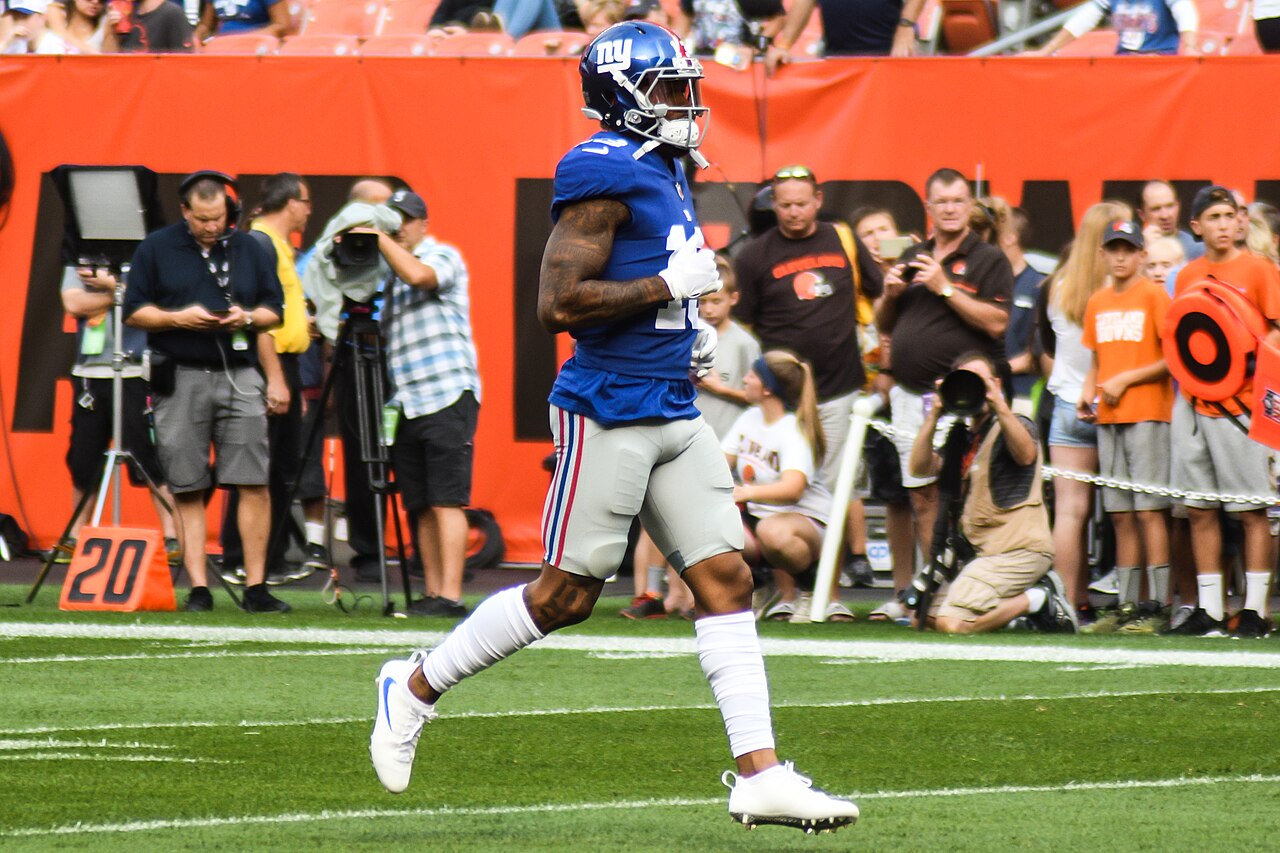
Odell Beckham Jr.’s second New York Giants chapter ended almost before it began. The receiver returned to the franchise that drafted him, reclaimed No. 13, made the 53-man roster—and was released on September 29 after three regular-season games, about 20 offensive snaps and one target. He did not record a catch.
That line is stark. It is also incomplete. Beckham’s brief homecoming says as much about how quickly the NFL prices age, role and roster flexibility as it does about one famous player at 33. A career once defined by an impossible-looking catch has reached the stage where every snap becomes an audition and nostalgia buys no guaranteed playing time.
A homecoming measured in weeks
The Giants signed Beckham on June 1, 2026, bringing him back to the club twelve years after it selected him 12th overall. The reunion carried obvious emotion: this was the team where he became a global sports celebrity, the place where a 43-yard, one-handed touchdown against Dallas on November 23, 2014 turned a rookie into an instant cultural reference.
He survived the summer roster cut and changed back into the number most closely associated with his rise. But the regular-season role never developed. New York’s September 29 transaction report listed Beckham as a terminated vested veteran. The club simultaneously promoted wide receivers Braxton Berrios and Charlie Jones from its practice squad, a sequence that showed where its immediate roster priorities had moved.
| Key fact | Verified detail | Why it matters |
|---|---|---|
| Return | Signed June 1, 2026 | A reunion with the franchise that drafted him |
| 2026 production | Three games, one target, no receptions | The offense never created a sustained role |
| Transaction | Released September 29 as a vested veteran | He is free to pursue another opportunity |
| Career production | 575 catches, 7,987 yards, 59 touchdowns | The three-game ending should not eclipse the larger résumé |
What the roster move really says
No public transaction notice can fully explain a coaching staff’s internal calculation. Still, the surrounding facts allow a reasonable reading. Beckham was not receiving meaningful offensive volume, and New York chose two other receivers for active-roster places. That is not proof that he can no longer play; it is evidence that the Giants no longer saw a role large enough to justify keeping him.
For veteran receivers, the equation is especially unforgiving. A younger reserve can often cover kicks, return punts and develop for future seasons while occupying the same roster spot. An established pass-catcher is usually retained to help the offense now. When that immediate contribution does not arrive, name recognition has little leverage against roster arithmetic.
This is the less glamorous side of the NFL’s weekly economy. Contracts, depth-chart fit, special-teams value and injury contingencies can matter as much as a player’s career highlights. Beckham’s release is therefore not simply a fall-from-fame story. It is a case study in how narrow the available lane becomes for a veteran attempting one more chapter.
The peak was historically high
Reducing Beckham to his final Giants stat line would distort what came before it. In his first five seasons with New York, from 2014 through 2018, he caught 390 passes for 5,476 yards and 44 touchdowns in 59 games. His 2014 rookie season produced 91 catches, 1,305 yards and 12 touchdowns despite missing the first four games. He won Associated Press Offensive Rookie of the Year and made three consecutive Pro Bowls from 2014 to 2016.
The catch against Dallas became bigger than a single touchdown. The NFL later ranked it No. 16 among the league’s 100 greatest plays, and his game-worn jersey entered the Pro Football Hall of Fame’s collection. For a generation raised on replay clips, social media and receiver gloves, Beckham helped redraw the visual language of the position: one hand extended, body nearly horizontal, control somehow maintained.
| Year | Chapter | What changed |
|---|---|---|
| 2014 | Giants rookie | 91 catches, 1,305 yards, 12 TDs; Offensive Rookie of the Year |
| 2015–16 | Elite receiver | Two second-team All-Pro selections and three straight Pro Bowls overall |
| 2019 | Cleveland | The Giants traded him to the Browns, ending his first New York run |
| 2021 | Los Angeles Rams | Won Super Bowl LVI, but suffered a torn ACL in the game |
| 2022–25 | Interrupted comeback | Missed 2022, played for Baltimore in 2023 and Miami in 2024, then did not play in 2025 |
| 2026 | Giants return | Made the roster, appeared in three games and was released September 29 |

A Black sports icon with a global audience
Beckham’s appeal never stopped at the boundaries of an NFL market. The son of two Louisiana State University athletes, he emerged at the intersection of elite performance, fashion, music and the social-media highlight economy. His hairstyles, celebrations and spectacular catches were copied and debated far beyond New York—including among young fans across Africa, the Caribbean, Europe and the wider Black diaspora who increasingly encounter American football through clips before full games.
That cultural reach can make the end of a roster stint feel larger than the transaction itself. But celebrity creates a difficult double standard: the public remembers the peak in high definition while teams judge the present in granular practice reps and weekly assignments. Both versions are real. The icon exists, and so does the player trying to prove he can still separate, stay healthy and help a team on Sunday.
What happens next
- Another team can call. As a released vested veteran, Beckham can negotiate a new opportunity.
- The role will matter more than the brand. A contender would need a defined use for him, not merely a recognizable name.
- Health remains central. His post-ACL years have included long absences and limited production.
- Retirement is not the only off-field path. Media, fashion and business already sit naturally within the public identity he built, whether or not he takes another NFL snap.
There may still be football left. A midseason injury elsewhere can change a depth chart overnight, and experienced receivers remain valuable when they can quickly learn assignments. But the Giants chapter is a warning against assuming that a sentimental return automatically produces a storybook ending.
The Afridiaspo takeaway
Beckham’s homecoming lasted three games and ended without a catch. His legacy will last much longer because it rests on more than this final line: an extraordinary early peak, a championship ring, a play preserved by the Hall of Fame and a visual influence that travelled globally.
The harder question is not whether the 2026 reunion failed—it plainly did. It is whether audiences can hold two truths at once: that Beckham changed what millions imagined a receiver could do, and that professional sport eventually asks even its most magnetic stars to earn tomorrow without credit for yesterday.
Sources
- New York Giants: Week 4 roster moves, September 29, 2026
- New York Giants: Beckham returns, career statistics and franchise context
- New York Giants player biography and career totals
- NFL 100 Greatest: Beckham’s 2014 catch ranked No. 16
- New York Giants: game-worn jersey enters Pro Football Hall of Fame collection
- Reuters/Field Level Media: Giants release Beckham after three games