QCHIMPANZEES IN UGANDA LOCKED IN VICIOUS 'CIVIL WAR', SAY RESEARCHERS
— Mary Ene
A groundbreaking study published in the journal Science on April 9, 2026 has revealed that the world's largest known group of wild chimpanzees — the Ngogo community in Uganda's Kibale National Park — has been engaged in a deadly civil war since 2018, after fracturing into two rival factions beginni…
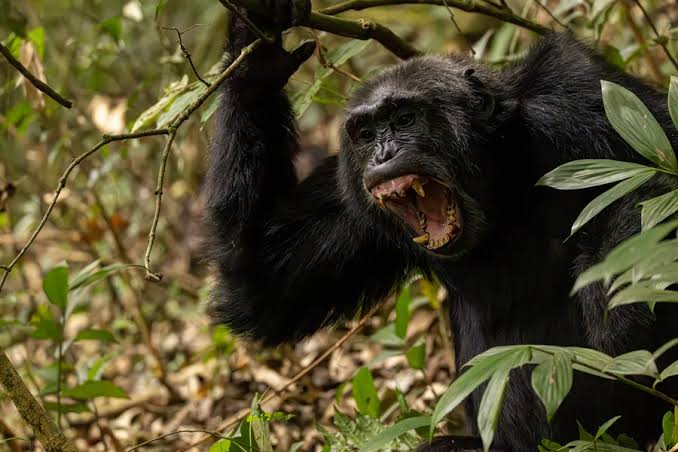
Deep in the ancient rainforests of Uganda, a war has been raging for nearly a decade not between nations or armies, but between neighbours who once shared food, groomed each other's fur, and raised their young side by side.
The world's largest known group of wild chimpanzees recently burst into lethal conflict. Much like in a human civil war, the group fractured into two factions. Then one side began killing its former companions on the other. It is an exceedingly rare event: scientists estimate that chimpanzee communities split, on average, only once every 500 years. The study, led by evolutionary anthropologist Aaron Sandel of the University of Texas at Austin and co-authored by John Mitani of the University of Michigan, was published in the journal Science on April 9, 2026, and has already been described by fellow primatologists as a landmark in the field.
The Ngogo chimpanzees of Kibale National Park have been studied continuously for nearly 30 years, giving researchers an extraordinary longitudinal dataset with which to trace the origins of the conflict. Back in 1995, the community was a single unified group at one point numbering more than 200 individuals, making it the largest habituated chimpanzee community ever studied. For two decades, the chimps lived in relative harmony, intermingling across two primary social clusters the Central and Western groups with cross-group mating, shared territory, and the ordinary rhythms of chimpanzee life: grooming, feeding, patrolling and forming friendships that lasted years.
Then, in 2015, something shifted. Just after a new alpha male was crowned, primatologists began noticing an inexplicable change. The two social clusters started to harden into distinct factions. Cross-group mating stopped.
On June 24, 2015, when members of the Western and Central clusters approached each other near the centre of their shared territory, the Western chimpanzees ran away and the Central chimpanzees chased them. A six-week period of avoidance followed. Researchers noted it was unlike anything previously observed in this community. What had been the heart of the Ngogo range was becoming a contested border.
By 2017, the Western group began making targeted territorial patrols into Central territory. The following year, the deadly violence began in earnest.
Between 2018 and 2024, Western chimps killed seven adult males and 17 infants from the Central group in coordinated, sustained attacks. A further 14 adolescent or adult Central males disappeared without trace, their bodies never recovered and given that they had shown no signs of illness, researchers believe at least some were also killed. The Western group, despite starting as the smaller faction, has grown its population from 76 to 108 individuals over the period of the conflict. The Central group has experienced a stepwise decline. It is, by every measurable metric, a one-sided rout.
The attacks have been vicious and deliberate. Researchers directly observed Western chimps ripping infants from their Central mothers' chests and battering them to death. They documented patrol groups marching single-file to find victims at the edges of territory, surrounding isolated individuals, and overwhelming them through coordinated group violence. One of the most striking documented cases involves Basie, a 36-year-old male who had lived peacefully in the community for his entire life. On the last full day of his life, after an ordinary day of foraging and socialising, a patrol group of approximately 13 Western adults arrived as daylight faded. Three adults surrounded him. Ten chimps attacked him on the ground simultaneously.
What caused the split? Researchers offer several interacting explanations. Mitani suggests the Ngogo chimps were "victims of their own success" the community had grown so large that individuals could no longer maintain the social bonds needed to hold it together. In 2014, five adult male chimps died within a single month, possibly from disease. These individuals had served as social connectors between the emerging factions and their sudden loss may have removed the bridges that kept the community unified. Reproductive competition may also have played a role: Central males appear to have lost access to females in the Western cluster before the war broke out, creating a sense of exclusion that fuelled resentment and eventually violence.
Crucially, the conflict is not over. Researchers confirmed that attacks have continued in 2025 and 2026. The civil war is ongoing. And yet amid the violence, researchers also documented acts of tenderness one 53-year-old chimp named BF approached the dying Basie after he had been attacked, reportedly a close friend of over a decade. The coexistence of lethal warfare and deep personal bonds within the same population struck researchers as one of the most thought-provoking findings of the entire study.
For scientists, the most important implication of the Ngogo civil war is what it says about human societies. Sandel put it directly: "Civil war is troubling to people. How can you turn on your neighbour? And I think by looking at this study in chimps, it sort of strips away a lot of aspects of human war, and we can see just how group identities can shift and lethal aggression can arise." The findings show that in one of humanity's closest living relatives, group identity alone — without ethnicity, religion, political ideology or resource competition is sufficient to fracture a once-unified community and ignite sustained, deadly violence. It is both a scientific breakthrough and a mirror.
QCHIMPANZEES IN UGANDA LOCKED IN VICIOUS 'CIVIL WAR', SAY RESEARCHERS