Ricardo Malajika’s Tokyo Test Is Bigger Than One Belt
— Afridiaspo Sports Desk
South Africa’s Ricardo Malajika faces Japan’s Tomoya Tsuboi for the vacant WBC super-flyweight title. Records, career paths, tactical keys and why it matters.
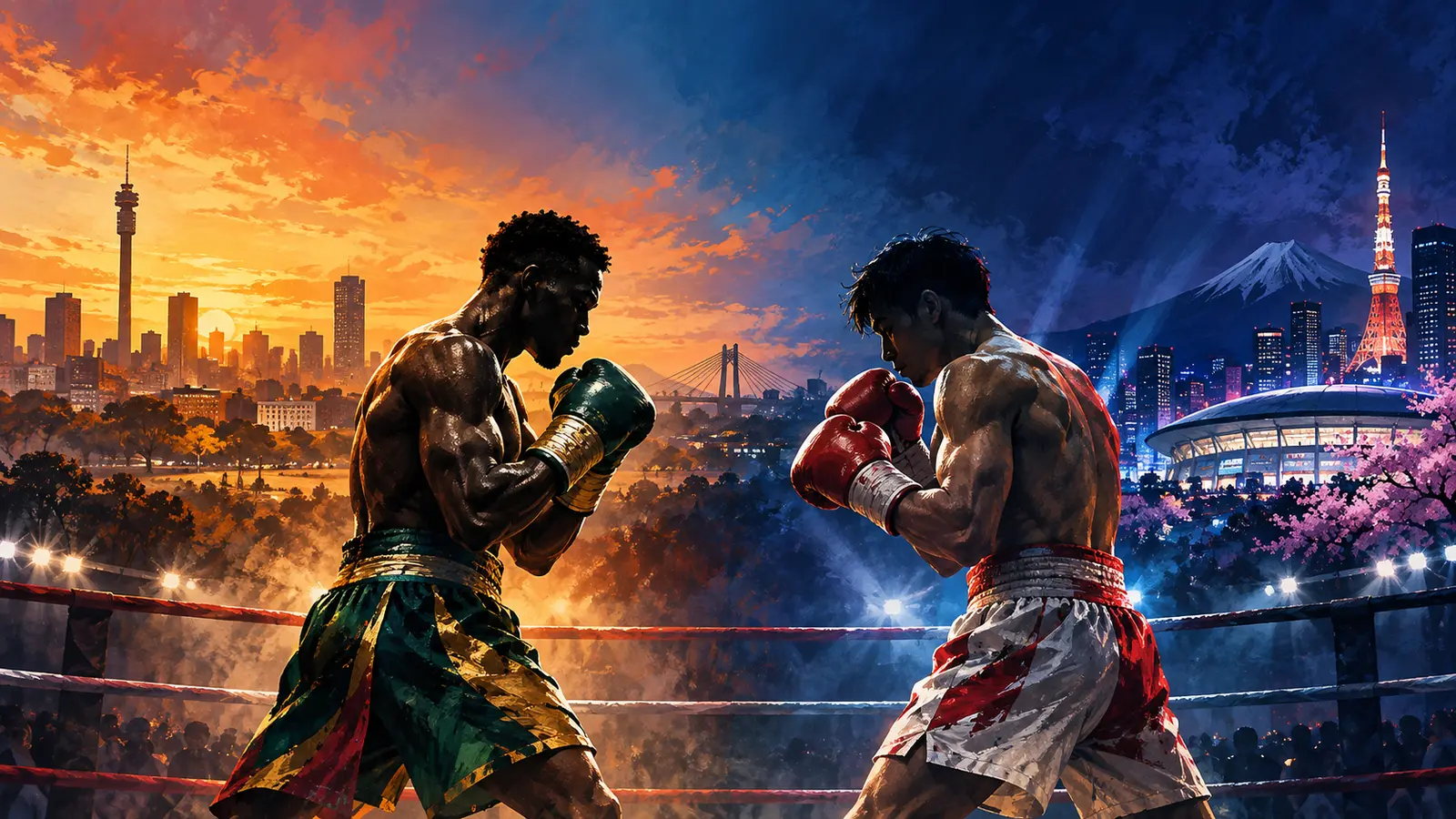
On Sunday, September 27, a South African champion will walk into a Tokyo arena carrying much more experience than the man across the ring—and far less home advantage.
Ricardo “Magic Man” Malajika is scheduled to face Japan’s Tomoya Tsuboi at Toyota Arena Tokyo for the vacant WBC super-flyweight world title. It is a matchup built on an arresting imbalance: Malajika has completed 19 professional fights and won 12 by knockout; Tsuboi has only three professional victories, plus one no-contest, but brings the polish of a 2021 amateur world champion.
For Malajika, the assignment is not simply to beat a talented opponent. He must show that the long apprenticeship of an African-based professional can travel: from Emperors Palace in Gauteng, where nearly his entire career has been built, to a Japanese stage designed around a celebrated home fighter.
Fight at a glance
- Bout: Ricardo Malajika vs Tomoya Tsuboi
- Stakes: Vacant WBC super-flyweight world title
- Date: Sunday, September 27, 2026
- Venue: Toyota Arena Tokyo, Japan
- Records: Malajika 17–2 (12 KOs); Tsuboi 3–0 with one no-contest
Two routes to the same title
Malajika’s route has been recognizably professional. He debuted in October 2018, learned through two decision losses, rebuilt, won the IBO super-flyweight title in 2023 and defended it against opponents with different styles. Along the way, he also stopped Jackson Chauke in two rounds to win an IBO flyweight title, demonstrating that his power did not disappear when he moved down a division.
Tsuboi’s route is compressed. He entered the professional game in March 2025 after a long elite amateur career. At the 2021 world championships in Belgrade, he defeated Kazakhstan’s Makhmud Sabyrkhan in the bantamweight final, becoming Japan’s first gold medallist at the men’s world championships. The International Boxing Association’s account of that final emphasized his patience, timing, double shots and ability to win the battle of distance.
Those qualities help explain why Tsuboi has moved so quickly. His professional record is small, but it is not the record of an ordinary novice. His early opponents included former world champions Carlos Cuadras and Pedro Guevara. The question is whether amateur sophistication and accelerated matchmaking can substitute for Malajika’s years of professional rounds, body punching, setbacks and title-fight pressure.
| Measure | Ricardo Malajika | Tomoya Tsuboi |
|---|---|---|
| Professional record | 17–2, 12 KOs | 3–0, one no-contest |
| Professional debut | October 2018 | March 2025 |
| Pro championship experience | IBO champion at super-flyweight; also won an IBO flyweight title | WBO Asia-Pacific bantamweight title |
| Defining preparation | Nineteen professional bouts and multiple 12-round title fights | 2021 amateur world champion with elite international tournament experience |
| Central question | Can his power and professional seasoning travel? | Can elite technique overcome a major experience gap? |
Malajika’s career changed after the second loss
The most useful way to understand Malajika is not through the two defeats on his record, but through what happened after them.
He lost a split decision to Sabelo Ngebinyana in March 2021, then a unanimous decision to Sikho Nqothole in April 2022. Since that second setback, he has won nine consecutive bouts. That run includes early knockouts, a late stoppage and full-distance decisions—the range of outcomes that builds professional judgment.
He captured the vacant IBO super-flyweight title by outpointing Kevin Luis Muñoz in September 2023. He then retained it against Marcel Braithwaite, stopped Yanga Sigqibo in the 11th round, floored Jayson Mama repeatedly before a fifth-round stoppage and went 12 rounds to defeat Vince Paras in November 2025.
The sequence matters. It shows a fighter who can carry his work beyond the opening exchanges, not simply a puncher waiting for one clean moment. It also means Malajika has already experienced the slower, more uncomfortable parts of a championship fight: making adjustments after a difficult round, keeping discipline when a stoppage does not come and preserving concentration late.
The danger in calling Tsuboi inexperienced
Three professional victories can look like a thin résumé. In Tsuboi’s case, that number hides more than it reveals.
Elite amateur boxing rewards quick tactical reading. Fighters meet different styles in compressed tournaments, often with little time to recover or redesign a game plan. Tsuboi’s 2021 world-title run required him to negotiate that environment and finish the tournament by beating Sabyrkhan 5–0 on the judges’ cards.
His professional rise has been deliberately fast. A fighter who has already spent years at international amateur level does not need the same developmental schedule as a raw debutant. Yet professional championship boxing asks different questions: longer rounds, sustained body work, smaller gloves, more time for an opponent to adjust and a scoring rhythm that can punish moments of inactivity.
That is the fascinating tension in Tokyo. Tsuboi owns the cleaner international amateur pedigree. Malajika owns the deeper professional memory.
Three contests inside the contest
1. Distance versus pressure
Tsuboi’s amateur success was built on timing and control of range. Malajika’s record suggests that he must make the fight physical enough to test whether that control survives prolonged pressure. This does not mean reckless pursuit. Chasing a skilled counterpuncher can hand him the very distance he wants. Malajika’s task is to close the ring patiently, take away exits and make Tsuboi work after every exchange.
2. The body before the head
A quick, technically gifted opponent is hardest to solve when his legs remain fresh. Sustained body work can reduce that freedom over time. For Malajika, investing downstairs would serve two purposes: it could slow Tsuboi’s movement and force his guard to make choices. But every body attack also creates a countering window. The South African must enter behind structure, not hope.
3. The scorecards in the middle rounds
Malajika cannot wait until the championship rounds to announce himself. Fighting abroad does not automatically mean unfair judging, and no result should be prejudged. It does mean that a visiting boxer benefits from making his best work unmistakable. Clean, visible scoring punches and sustained initiative in rounds four through eight may matter more than a dramatic late chase.
A career chronology worth carrying to Tokyo
| Date | Milestone | Why it matters |
|---|---|---|
| October 2018 | Professional debut | Began an eight-year apprenticeship largely built in Gauteng. |
| April 2022 | Second career defeat | The last loss before his current nine-fight winning streak. |
| September 2023 | Won IBO super-flyweight title | Proved he could complete 12 rounds and win a world-level belt. |
| March 2025 | Stopped Jackson Chauke in round two | Added an IBO flyweight title and showed power across divisions. |
| November 2025 | Outpointed Vince Paras | Retained the super-flyweight belt in his most recent completed bout. |
| September 27, 2026 | Scheduled WBC title fight in Tokyo | The biggest global platform and most consequential test of his career. |
Why this fight matters beyond one boxer
African boxing has never lacked talent. The harder problem is turning talent into durable international opportunity: regular high-level competition, promotional leverage, global television exposure and pathways that do not require a fighter to leave home before the world takes notice.
Malajika’s path offers both encouragement and warning. He built a credible championship record in South Africa, defeated visiting opponents and earned a shot at a widely recognized world title. Yet the decisive step still takes place thousands of kilometres away, against a home boxer whose amateur achievements made him an immediate international commodity.
A Malajika victory would be personal, but its commercial meaning would travel. It could make South African cards more relevant to global matchmaking, give younger regional champions a recent example of an Africa-based route to a major belt and widen the audience for the lighter weight classes, where African fighters have often produced excellence without receiving heavyweight attention.
For Africans in the diaspora, the fight is also a reminder to look beyond the names that dominate English-language promotion. The super-flyweight division rewards speed, judgment and craft. Tokyo’s title bout offers all three, plus a question with genuine emotional weight: can a career built patiently at home survive its most compressed, hostile examination abroad?
What to watch for
- Whether Malajika can cut off the ring without overreaching.
- How Tsuboi responds to sustained body attacks and longer professional exchanges.
- Who controls the middle rounds, before fatigue changes the pace.
- Whether Malajika’s power forces Tsuboi out of his preferred rhythm.
- Whether Tsuboi’s timing makes Malajika reset before he can build combinations.
The Afridiaspo takeaway
The easy version of this story is experience against talent. The more accurate version is experience against a different kind of experience.
Malajika has learned the professional trade one bout at a time: through losses, domestic rebuilds, title rounds and opponents who refused to disappear. Tsuboi learned through international amateur tournaments where every round could end a campaign and every style demanded a fast answer.
Tokyo will decide which education transfers better under championship lights.
If Malajika wins, the belt will be the visible prize. The deeper achievement will be proving that a boxer can build the substance of a world-level career in South Africa and carry it intact to the sport’s most demanding international rooms.
Sources: Fight date, venue and records were checked against BoxRec’s Ricardo Malajika record and the September 26–27 boxing schedule. The WBC order and contender positions were reported by TimesLIVE. Tsuboi’s 2021 amateur world title and technical background were verified through the International Boxing Association; his current professional record was checked against BoxRec.