STRATEGIC SAVINGS: YOUR GUIDE TO THE LATEST US AND EURO CERTIFICATE RATES
— Mary Ene
Certificate of Deposit (CD) rates in the United States remain competitive in April 2026, with the best rates reaching up to 4.25% APY despite a general downward trend following three consecutive Federal Reserve rate cuts in late 2025. The Fed has held rates steady at 3.50%–3.75% in both its January…
If you have savings sitting idle in a standard bank account, you are almost certainly leaving money on the table. The Certificate of Deposit market in 2026 still offers some of the best risk-free returns available to ordinary savers but the window is narrowing, and knowing where to look makes all the difference.
A Certificate of Deposit known as a CD in the United States and as a fixed-term savings account or fixed-rate bond in European markets is one of the most reliable tools in any saver's toolkit. You deposit a fixed sum for an agreed period, receive a guaranteed interest rate throughout that period, and collect your principal plus interest at maturity. The trade-off is access: withdraw early and you face a penalty, typically calculated as a fixed portion of the accrued interest. In exchange for that restriction, CDs almost always pay significantly more than standard savings or checking accounts. In April 2026, that premium remains real and meaningful.
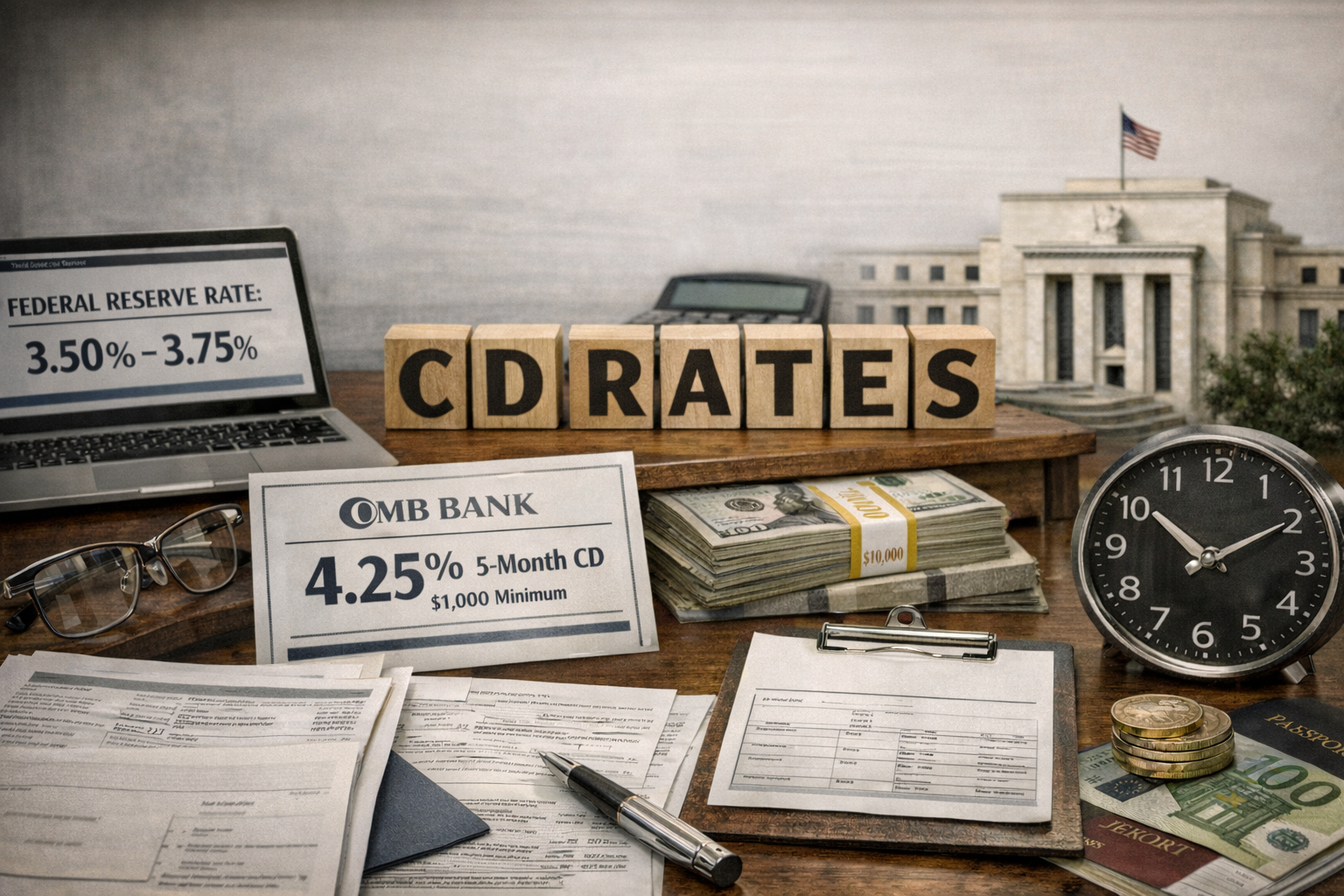
The Federal Reserve cut its benchmark interest rate three times in succession during the final months of 2025, taking the federal funds rate from 4.25%–4.50% down to its current level of 3.50%–3.75% the lowest it has been since September 2022. In its January 2026 and March 2026 meetings, the Fed held rates unchanged, but market expectations suggest further cuts are possible later in the year. This creates a straightforward strategic imperative for savers: lock in rates now, before they fall further. CD rates typically move in step with Fed decisions, and the direction of travel is likely downward.
Despite the decline from the highs of 2024 when the best short-term CDs were reaching 5% the current market still offers genuinely competitive returns. The best CD rates available in April 2026 range from approximately 2.75% to 4.25% APY, depending on the term length and institution. OMB Bank is currently offering a 4.25% APY on a 5-month CD with a $1,000 minimum deposit among the highest rates on the market.
Newtek Bank is offering 4.20% APY on a 9-month CD, with a $2,500 minimum. Bread Savings is offering 4.15% APY on a 9-month CD. LendingClub and OMB Bank are both offering 4.15% APY on 8-month and 7-month CDs respectively. For savers willing to commit for a full year, E*TRADE from Morgan Stanley offers 4.10% APY on a 1-year CD with no minimum deposit requirement an unusually accessible entry point.
Longer-term CDs naturally carry different considerations. For a three-year term, United Fidelity Bank is offering 4.10% APY with a $1,000 minimum — well above the 2% average that was typical for this term length in earlier cycles. For a five-year CD, Sallie Mae offers a solid 4.00% APY with a $2,500 minimum, locking in a fixed return that would outperform most bond alternatives at this risk level. For the genuinely long-term saver willing to commit a decade, First National Bank of America offers 3.80% APY on a 10-year CD with a $1,000 minimum deposit. The key principle across all these options is the same: in a declining rate environment, duration is your friend.
Online banks consistently outperform traditional branch-based institutions on CD rates a structural feature of the market that has become even more pronounced in 2026. Without the overhead costs of maintaining physical branches, online banks can offer depositors a larger share of the returns they generate from lending those same deposits. Savers comparing CD rates should therefore prioritise the online banking universe, which includes institutions such as Marcus by Goldman Sachs, Synchrony Bank, Sallie Mae and E*TRADE. Marcus offers a competitive 4.00% APY on its 1-year CD with a $500 minimum, combining strong rates with the reassurance of Goldman Sachs brand recognition. Its early withdrawal penalties are also notably lower than many competitors.
For savers who want competitive returns without completely surrendering access to their funds, no-penalty CDs offer a middle path. Marcus by Goldman Sachs offers a no-penalty CD at 3.95% APY with a $500 minimum allowing holders to withdraw their full balance without a penalty after a short initial period. While slightly lower than the best standard CD rates, the flexibility premium is modest and the trade-off is worth considering for savers who may need to access funds before maturity. Jumbo CDs traditionally defined by minimum deposits of $100,000 are also available with competitive rates: Credit One is offering the best 1-year Jumbo CD at 4.15% APY.
For European savers, the landscape is shaped by the European Central Bank's own rate trajectory. The ECB raised rates aggressively through 2022 and 2023 to combat inflation, and fixed-term savings rates across the eurozone improved dramatically as a result. European savers should compare fixed-term savings products offered by both traditional banks and digital challengers, with rates typically ranging from 2% to 3.5% depending on the member state, institution and term length. German direct banks such as ING Diba and DKB, as well as pan-European savings platforms such as Raisin, continue to aggregate the best available fixed-term rates from across the EU, allowing savers to access deposit products from institutions in multiple countries all covered by national deposit guarantee schemes up to €100,000.
The fundamental strategic message for savers in both markets is consistent: act now rather than wait. The Federal Reserve and ECB have both signalled that the long period of elevated rates is ending, and every month of delay potentially means locking in at a lower rate. A CD ladder dividing savings across multiple CDs with staggered maturity dates is widely recommended by financial advisors as a way to balance the desire for high fixed rates with the need for periodic access to funds. All CDs at FDIC-member banks in the US are insured up to $250,000 per depositor, per institution, per ownership category making them among the safest financial products available. The risk is not default. The risk is waiting too long to use them.
STRATEGIC SAVINGS: YOUR GUIDE TO THE LATEST US AND EURO CERTIFICATE RATES