Sudan’s Burhan Faces a UN Visa Standoff—Here’s Why It Matters
— Afridiaspo Immigration & Diaspora Desk
Why Sudan’s Burhan has not received a U.S. visa for the UN General Assembly, what the host-country agreement requires and why Africans should care.
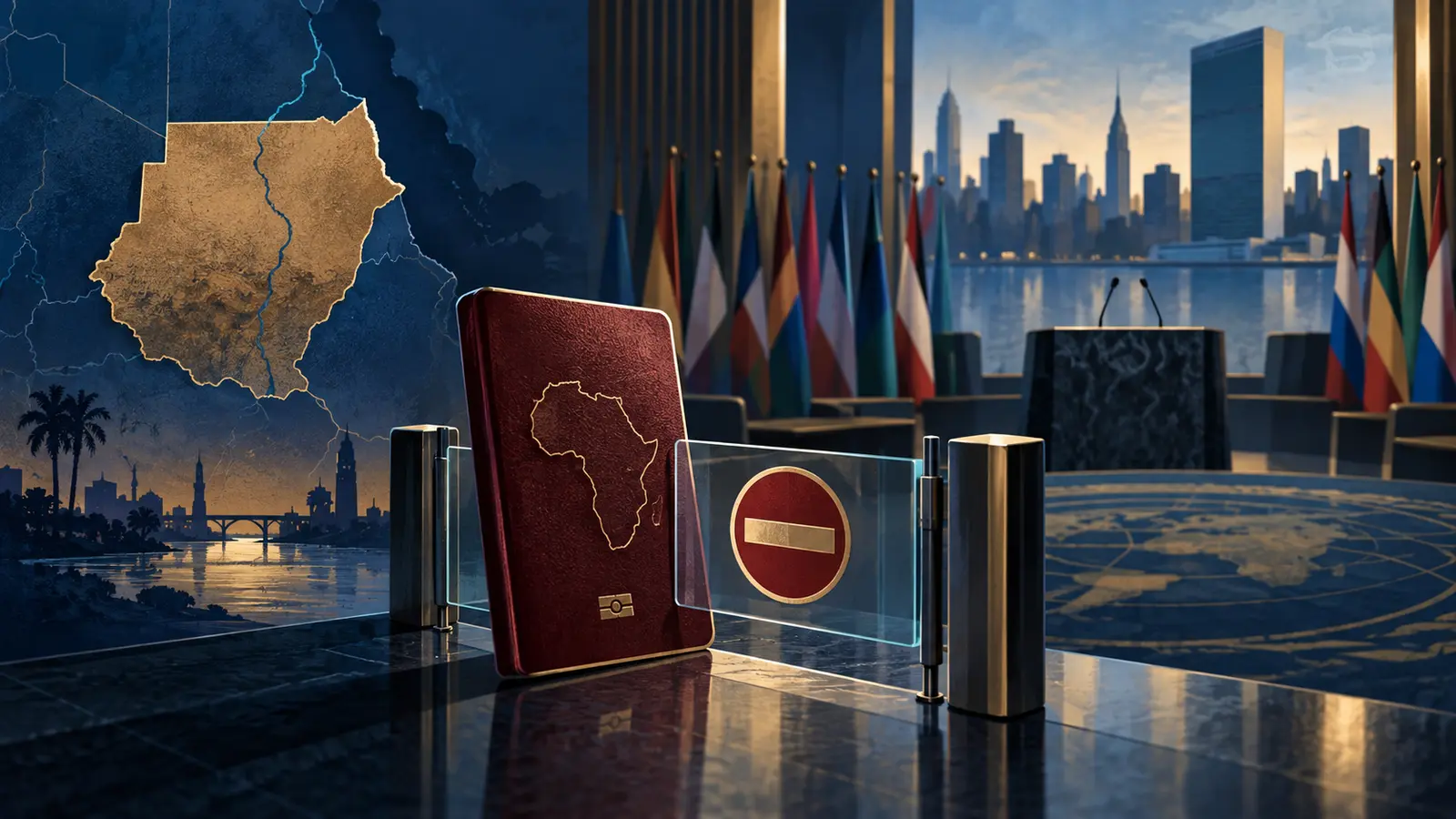
An empty chair at the United Nations can say almost as much as a speech. This week, the chair that may remain empty belongs to Sudan’s army chief, Abdel Fattah al-Burhan—and the reason is not a cancelled flight or a change of schedule. It is a visa dispute that reaches beyond one traveller, one government or even one war.
On September 22, Reuters reported that the United States had not issued Burhan a visa in time for his planned appearance at the United Nations General Assembly in New York. Sudanese and other sources told the news agency that Washington had linked his attendance to acceptance of a proposed 90-day ceasefire in Sudan’s civil war.
The distinction matters: as of the report, Burhan had not received formal notice that his visa was denied. His trip had been postponed, the U.S. State Department had not publicly responded to Reuters’ request for comment, and Sudan’s foreign minister was expected to deliver the country’s address instead.
That leaves a live diplomatic dispute, not a settled fact pattern. But it also raises a larger question: when the United States hosts the United Nations, how far can ordinary visa power reach into the representation of another member state?
Image credit: Afridiaspo original editorial illustration. This is a symbolic artwork, not a documentary photograph of Burhan, the United Nations or the reported visa decision.
What is known—and what remains an allegation
| Established by current reporting | Not yet independently established |
|---|---|
| A visa had reportedly not been issued to Burhan by September 22. | That the United States had issued a formal written denial. |
| Burhan postponed his planned New York trip, according to a senior Sudanese source. | The State Department’s full legal or policy rationale. |
| Sudan’s UN ambassador asked Secretary-General António Guterres to intervene. | Whether Burhan would receive a visa later. |
| The UN said the secretary-general was deeply concerned and was engaging U.S. authorities. | Whether the reported 90-day ceasefire condition was official U.S. policy. |
| Sudan’s foreign minister was expected to speak in Burhan’s place. | Whether the standoff would change either side’s position on the war. |
Reuters said a Sudanese diplomatic source and a Western analyst with knowledge of U.S.-Sudanese contacts connected the visa delay to a ceasefire plan advanced by Massad Boulos, the U.S. senior adviser for Arab and African affairs. The Sudanese army had already expressed reservations about that proposal in July.
Sudan’s UN ambassador, Al-Harith Idriss Al-Harith, wrote to Guterres on September 21 requesting immediate intervention. The concern, as described in the letter, was that the visa situation could prevent the head of a UN member state’s delegation from participating in person.
UN spokesperson Stéphane Dujarric told Reuters that Guterres was deeply concerned that a visa had reportedly not yet been issued and was engaging the United States on the matter.
This is not an ordinary visitor-visa dispute
The United States has sovereign authority over its borders. But New York is also the seat of the United Nations, and that role comes with treaty obligations that do not apply to an ordinary tourist, business visitor or immigrant.
The 1947 agreement between the United Nations and the United States was designed to prevent the host country from using domestic entry rules to obstruct access to UN headquarters. Section 11 protects transit to and from the headquarters district for representatives of member states and other covered persons. Section 13 says U.S. immigration laws should not be applied in a way that interferes with those privileges and that required visas should be granted without charge and as promptly as possible.
The UN Committee on Relations with the Host Country regularly reviews visa delays, entry restrictions and other access problems under that agreement. The committee exists because the credibility of a global institution depends, in part, on whether delegations can physically reach it.
That does not automatically resolve every dispute. Questions can arise over security, recognition, sanctions and the identity of a government’s representative. But the starting principle is clear: hosting the UN is not the same as hosting a meeting controlled solely by U.S. foreign policy.
The man at the centre of the dispute
Burhan is not a neutral or uncontroversial figure. He heads the Sudanese Armed Forces and has been the country’s de facto leader since 2019. In 2021, he and Rapid Support Forces commander Mohamed Hamdan Dagalo—widely known as Hemedti—removed Sudan’s civilian leadership in a military takeover. The African Union and Western governments withdrew recognition after that coup.
The former partners then went to war in April 2023. Sudan’s conflict has devastated cities, displaced millions and generated what the United Nations has described as the world’s largest humanitarian crisis. The army and the RSF have both faced allegations of grave abuses, while international mediation has repeatedly failed to produce a durable end to the fighting.
Burhan has represented Sudan at previous General Assembly sessions. His position is that externally imposed ceasefires can allow the RSF to regroup. U.S. mediators and their regional partners argue that a pause is urgently needed to reduce civilian suffering and open space for negotiations.
Those competing positions explain the pressure behind the reported visa standoff. They do not, however, erase the host-country question.
A short chronology of the standoff
| Date | Development | Why it matters |
|---|---|---|
| April 2023 | War breaks out between the Sudanese Armed Forces and the RSF. | The conflict creates a vast humanitarian emergency and repeated but unsuccessful mediation efforts. |
| July 2026 | Sudan’s army voices reservations about a U.S.-backed 90-day ceasefire proposal. | The ceasefire becomes the reported point of leverage in the later visa dispute. |
| September 21 | Sudan’s UN ambassador writes to Guterres requesting intervention over Burhan’s visa. | The disagreement moves formally into the UN host-country relationship. |
| September 22 | Reuters reports that the visa has not been issued and that Burhan’s trip is postponed. | The unresolved application threatens his planned in-person address. |
| Expected next step | Sudan’s foreign minister is expected to address the General Assembly instead. | Sudan retains a voice in the hall, but the dispute over the delegation’s chosen representative remains. |
Why the United States may see leverage—and why that is risky
From Washington’s perspective, the humanitarian stakes in Sudan are enormous. A ceasefire could save lives, expand aid access and create space for diplomacy. Visa access to a high-profile UN gathering may appear to be one of the few pressure points available against a leader who rejects the proposed terms.
But tying a UN visa to a negotiating demand would carry its own costs if confirmed. It could blur the line between bilateral pressure and the host country’s institutional obligations. It could also give other states grounds to argue that access to multilateral forums depends on political compliance with the country where those institutions happen to be located.
That precedent would not affect only Sudan. Many African and Global South governments already argue that international institutions are structurally unequal. If access to the General Assembly can appear conditional, even temporarily, it reinforces the perception that the rules of multilateralism are strongest for some states and negotiable for others.
Why Africans and the diaspora should care
This story is not about defending Burhan’s record. It is about separating two questions that can easily be collapsed.
The first is whether Sudan’s military leadership should be pressured to end a catastrophic war. The second is whether the United States, as UN host, should use entry access as that pressure. A person can support urgent ceasefire diplomacy while still insisting that the rules governing representation at the UN be applied consistently.
For Africans living in the diaspora, the issue also has a familiar resonance. Visas are never merely stamps and forms; they can determine who is present when decisions are made, whose testimony is heard and whose absence is interpreted by others. At the level of international diplomacy, the same gatekeeping power operates on a far larger stage.
African countries have long sought a stronger voice in global institutions. That voice depends not only on reforming seats and voting power but also on something more basic: reliable access to the rooms where global decisions are debated.
What happens next
- A late visa could still be issued. Reuters reported no formal denial, leaving room for the dispute to be resolved.
- Sudan can still address the Assembly. The foreign minister is expected to speak if Burhan remains absent.
- The UN can continue host-country consultations. Guterres has already raised the matter with U.S. authorities.
- The ceasefire dispute will continue beyond New York. A visa decision cannot substitute for negotiations over civilian protection, aid access, accountability and an end to the war.
The Afridiaspo takeaway
The most important test is not whether readers admire or condemn the person seeking entry. Rules matter most when they protect access for people whom the host government strongly opposes.
Sudan’s civilians need more than a debate over diplomatic travel. They need an end to violence, safe humanitarian access and a political process that restores civilian authority. Yet the method used to pursue those goals also matters. If the United Nations is to remain a forum for adversaries as well as allies, its doors cannot appear to open only when the host country approves of the visitor’s position.
Burhan’s reported visa standoff is therefore bigger than one postponed journey. It is a test of whether diplomatic pressure and institutional duty can remain distinct at the very moment both are under strain.
Sources: Reuters, September 22, 2026; United Nations Committee on Relations with the Host Country.
Sudan’s Burhan Faces a UN Visa Standoff—Here’s Why It Matters